
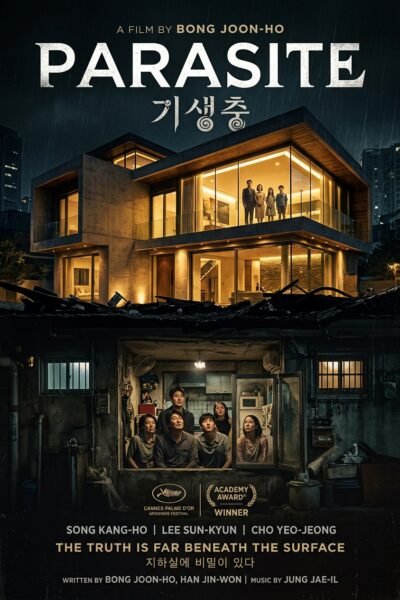
Introduction: A Film That Changed What Cinema Could Be
When Parasite won the Academy Award for Best Picture in February 2020, it made history as the first non-English language film to claim Hollywood’s most prestigious prize. But the award, however groundbreaking, barely scratches the surface of what Bong Joon-ho achieved with this extraordinary film. Parasite is one of the most precisely crafted, thematically rich, and emotionally intelligent films of the 21st century — a genre-defying work that functions simultaneously as black comedy, thriller, social satire, and tragedy, woven together with a technical mastery that makes every transition feel not just organic but inevitable.
What makes Parasite so remarkable is not any single element but the totality of its construction. Bong Joon-ho has been one of cinema’s most gifted filmmakers for two decades — Memories of Murder, The Host, Mother, Snowpiercer — but Parasite represents his complete creative arrival, the film in which every dimension of his talent converges perfectly. It is the rare film that becomes more impressive the more you analyze it, that reveals new dimensions with each viewing, that works as pure entertainment and as something genuinely profound at the same time.
📖 Also Read
-
▶ Joker (2019) Review – Joaquin Phoenix's Terrifying Portrait of a Man on the Edge
-
▶ The Zone of Interest (2023) Review – A Holocaust Film Unlike Any Other
-
▶ Poor Things (2023) Review – Emma Stone Shines in Lanthimos's Surreal Feminist Masterpiece
-
▶ Killers of the Flower Moon (2023) Review – Scorsese's Devastating American Epic
Plot: A Masterclass in Structural Elegance
The Kim family — father Ki-taek (Song Kang-ho), mother Chung-sook (Jang Hye-jin), son Ki-woo (Choi Woo-shik), and daughter Ki-jung (Park So-dam) — live in a cramped, damp semi-basement apartment in Seoul, barely scraping by. They fold pizza boxes for occasional income. Their phones get stolen. Their WiFi comes from an upstairs neighbor. They are not, the film is careful to show us, bad people — they are resourceful, funny, affectionate with each other, and simply trapped at the bottom of an economic system that has no use for them.
Their fortunes appear to change when Ki-woo’s friend, about to leave for university, asks him to take over tutoring the daughter of the wealthy Park family. Ki-woo arrives at the Park house — a stunning modern architectural masterpiece, all glass and stone and carefully tended garden — and immediately understands that he has entered a different world. He also immediately begins scheming, because the Kims are nothing if not opportunistic. Within weeks, through a series of increasingly elaborate deceptions, all four family members have infiltrated the Park household.
To describe what happens in the film’s second half would be to commit the worst possible spoiler crime. What I can say is that the film’s structure, which has been building with the careful inevitability of a pressure cooker, reaches a release point that fundamentally changes what kind of film you thought you were watching — and then it continues beyond that, into territory darker and more emotionally devastating than anything the first hour prepared you for. The architecture of the screenplay is extraordinary: everything planted in the first act pays off in the third, every joke has a shadow, every comfort contains a threat.
Direction: The Cinema of Controlled Perspective
Bong Joon-ho directs Parasite with a level of visual intelligence that rewards frame-by-frame analysis. The film’s most consistent visual motif is vertical space — stairs, floors, levels, the relationship between high and low. The Park family lives on a hill, in a house designed to capture light and views. The Kims live below street level, their apartment windows looking out on the ankles of passersby and the gutters where cigarettes are extinguished. When the film introduces a third underground space — a location I cannot describe without spoiling — the vertical metaphor achieves its full, nightmarish resonance.
The cinematography, by Hong Kyung-pyo, is precise and elegant. Bong uses wide shots to show us the spatial relationship between characters and their environments — the Kims always slightly cramped, the Parks always with room to breathe and expand. He uses close-ups sparingly, which makes them land harder when they arrive. And he uses the camera’s movement — or deliberate stillness — to create and release tension with extraordinary control.
The famous sequence in which the Kims must hide beneath a coffee table while the Parks return unexpectedly is a masterwork of sustained tension — played entirely for physical comedy that never loses its undercurrent of genuine dread. Bong holds shots longer than comfort allows, wrings every available drop of anxiety from the spatial logistics, and lands the sequence’s punchline with perfect timing. This is filmmaking craft of the highest order.
Performances: An Ensemble Without a Weak Link
The ensemble performances in Parasite are uniformly excellent in a way that suggests Bong Joon-ho is one of cinema’s great directors of actors. Song Kang-ho, one of South Korea’s finest performers and a Bong regular, anchors the film as Ki-taek — a man of genuine intelligence and warmth who has internalized his own powerlessness so completely that he has stopped making plans. His reading of a monologue late in the film about the value of having no plan — “If you make a plan, life never works out that way. If you make no plan, it doesn’t matter if things go wrong” — is both funny and heartbreaking. It is the philosophy of a defeated man who has turned defeat into wisdom.
Choi Woo-shik brings charm and quick intelligence to Ki-woo, making him a genuinely engaging protagonist even as his ethical compass wobbles. Park So-dam is magnetic as Ki-jung, the most cynically brilliant of the Kim siblings — the one who understands most clearly how the game works and plays it with the most verve. And Cho Yeo-jeong is quietly devastating as the Park wife, a woman whose genuine kindness coexists with a complete inability to see the human beings behind the service roles she assigns them.
Social Commentary: The Architecture of Inequality
Parasite’s social commentary operates at several levels simultaneously, which is part of what makes it so enduringly discussable. The most obvious level is the class critique: the film depicts a society in which birth circumstances determine life outcomes to such a degree that the talented, resourceful Kim family cannot escape poverty through legitimate means and must resort to deception, while the merely wealthy Park family coasts on inherited advantage. The Kims are clearly more intelligent and capable than their employers; the system has simply decided that intelligence and capability deployed without a résumé are worthless.
But Parasite goes further. It is not merely a film that criticizes inequality from the outside; it analyzes the psychology that inequality creates within people. The Kims do not hate the Parks — they admire them, want to be them, have partially absorbed the value system that places them below the Parks in the social hierarchy. Ki-taek’s attitude toward Park Dong-ik (Lee Sun-kyun), his employer, is complex: genuine respect for his success, genuine resentment of his casual condescension, and something approaching complicity in his own subordination.
The Title: Who Is the Parasite?
The film’s title is one of its great provocations. The obvious reading — the Kims as parasites upon the Parks — gives way to something more complicated upon reflection. The Parks cannot function without the labor of people like the Kims. They cannot drive themselves, teach their own children, clean their own house, manage their own garden. Their wealth, their comfort, their lifestyle — all of it depends entirely on the invisible labor of the people they employ and barely see as human beings. Who, then, is parasitic upon whom?
The Ending: No Easy Exits
Parasite’s final scenes are among the most emotionally complex in recent cinema. The film refuses the satisfaction of a moral lesson clearly delivered, a villain clearly punished, a hero clearly rewarded. What it offers instead is more truthful and more disturbing: a recognition that systems of inequality are not defeated by individual events, however violent, and that the people trapped at the bottom continue to dream of the heights even when they know the dream is impossible.
Our Rating: ⭐ 9.5 / 10
Verdict: Parasite is essential cinema — one of the most perfectly constructed films of the 21st century. It is accessible and entertaining and intellectual and emotionally devastating all at once. It rewards multiple viewings and repays careful analysis. It will be studied, taught, and discussed for decades. Watch it without reading spoilers.
Recommended For: Everyone. Parasite transcends language barriers, national contexts, and genre preferences. It is simply great filmmaking. Content Note: Violence, dark themes. Korean-language with subtitles.



Leave a Reply