
Introduction: Horror Without Showing Horror
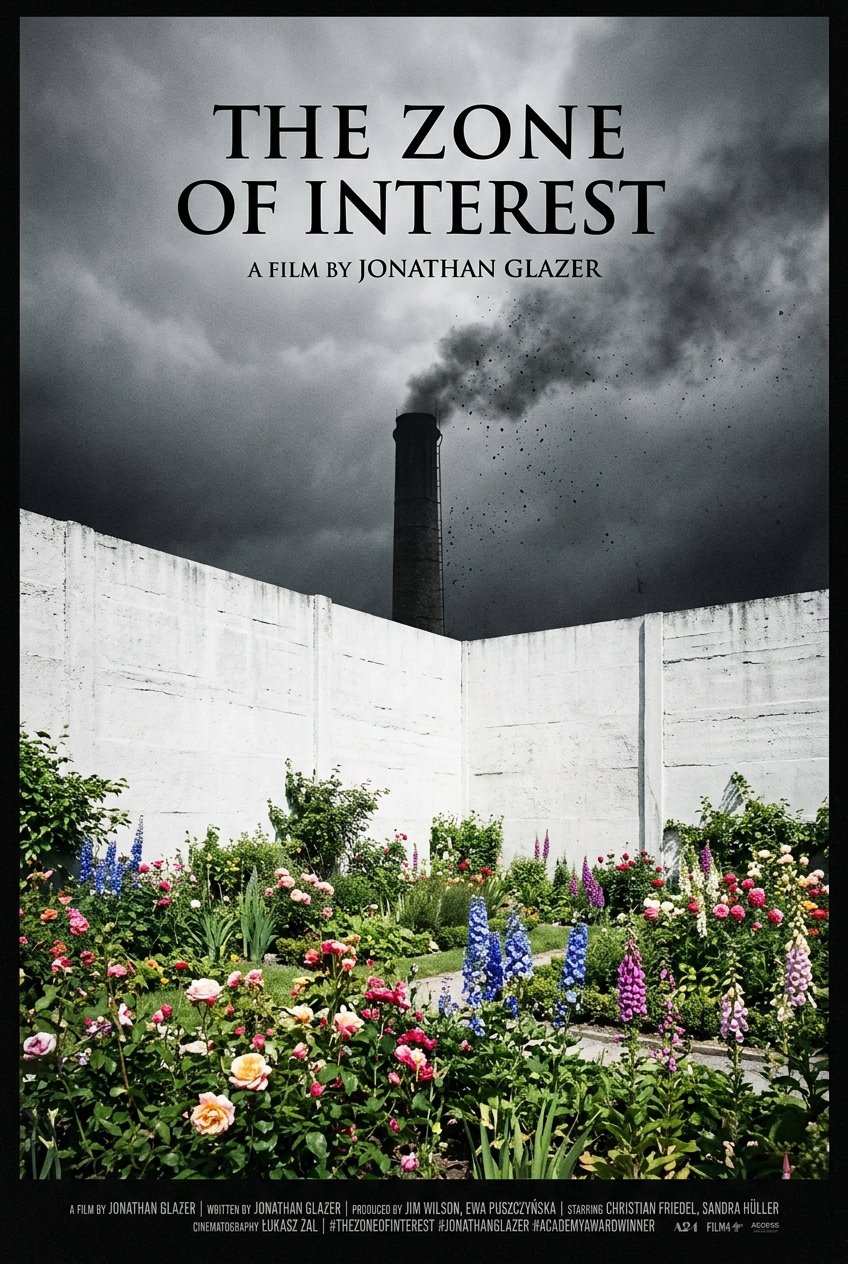
The Zone of Interest won the Academy Award for Best International Feature Film and the Grand Prix at Cannes, and it deserved both honors. Jonathan Glazer’s film about the family of Auschwitz commandant Rudolf Höss — living in comfortable domesticity in a house directly adjacent to the extermination camp — is the most formally radical and morally disturbing film in recent memory. It never shows us what happens inside the camp. It never needs to.
The Concept: Domesticity as Horror
The Höss family lives in a beautiful house with a well-tended garden. The children play. The wife, Hedwig, tends her flowers with evident pride — she calls the house her paradise. They host garden parties, go swimming, discuss domestic logistics with the same mundane specificity of any bourgeois family. And throughout all of it, the sounds of the camp bleed continuously into every scene: train sounds, distant commands, machinery, and sometimes, unmistakably, human suffering.
📖 Also Read
-
▶ Killers of the Flower Moon (2023) Review – Scorsese's Devastating American Epic
-
▶ Joker (2019) Review – Joaquin Phoenix's Terrifying Portrait of a Man on the Edge
-
▶ Poor Things (2023) Review – Emma Stone Shines in Lanthimos's Surreal Feminist Masterpiece
-
▶ Tár (2022) Review – Cate Blanchett's Towering Performance in Cinema's Most Complex Film
The family has normalized what is happening next door to a degree that is genuinely, deeply terrifying. Rudolf discusses camp logistics at the dinner table with the same tone he might use to discuss farm management. Hedwig refuses an opportunity to relocate when her husband is transferred, because she doesn’t want to leave her garden. The children play near a wall beyond which thousands of people are being murdered daily. None of them seem to register it as anything other than background.
Hannah Arendt Made Cinematic
Hannah Arendt’s concept of the “banality of evil” — introduced in her reporting on the Adolf Eichmann trial — describes the way that ordinary bureaucratic functioning can become complicit in extraordinary atrocity without the people involved experiencing themselves as evil, or even as particularly unusual. The Zone of Interest is the most complete cinematic realization of this concept. The Höss family are not presented as monsters; they are presented as ordinary people who have simply made certain accommodations with their situation. This is more disturbing than any monstrous caricature could be.
Glazer’s Formal Approach: Surveillance Cinema
Jonathan Glazer shot the film with multiple cameras placed throughout the house and garden in fixed positions, capturing the family’s movements with a quality that resembles surveillance footage more than conventional cinematography. The effect is deeply unsettling: we are watching rather than experiencing, observing rather than participating, positioned as witnesses with knowledge of what is happening next door that the family either doesn’t have or has chosen not to have.
Mica Levi’s score — sparse, electronic, deeply disturbing — is deployed only in specific sequences that interrupt the domestic naturalism: sequences involving a young girl who leaves food for prisoners in the fields, presented in infrared negative footage that suggests a different kind of vision, a different moral perspective.
Sandra Hüller: The Horror of Normalcy
Sandra Hüller plays Hedwig Höss with chilling precision — a woman of genuine domestic competence and genuine enjoyment of her privileged position who has constructed an inner world in which the camp next door simply does not register as a moral problem. Her Hedwig is not stupid, not ignorant, not uniquely cruel. She is disturbingly ordinary — which is the point, and which is genuinely horrifying.
Our Rating: ⭐ 9.2 / 10
Verdict: A masterwork of controlled, purposeful filmmaking. The Zone of Interest demands your full attention and repays it with something that will remain with you permanently. Essential Holocaust cinema and essential cinema, full stop. Not an easy watch — but one of the most important films of the decade.
Production Excellence and Technical Achievement
The Zone of Interest stands as a remarkable achievement in contemporary filmmaking — a film that succeeds not just as entertainment but as a genuine work of cinematic craft. The production team brought together exceptional talent across every department: the cinematography captures each scene with visual intelligence, the production design creates environments that feel authentic and purposeful, and the editing maintains precisely the rhythm the story requires.
The sound design and musical score deserve particular recognition. These sonic elements work in concert with the visual storytelling to create an immersive experience that engages the audience on multiple sensory levels simultaneously. The score, in particular, elevates key sequences beyond what the visuals alone could achieve — creating emotional resonance that persists beyond the specific moments it accompanies.
Themes and Cultural Resonance
What makes The Zone of Interest genuinely important rather than merely entertaining is its engagement with themes that extend beyond its immediate narrative. The film asks questions that resonate with contemporary experience: about identity and transformation, about the costs of ambition and the meaning of success, about the relationships between individuals and the communities and institutions that shape them. These themes are not imposed upon the story but emerge naturally from it, which is the mark of genuinely accomplished screenwriting.
The performances throughout are of exceptional quality. The central performance anchors the film with authenticity and emotional intelligence, making the character’s journey feel personally true rather than narratively convenient. The supporting cast creates a fully realized world around that central performance, ensuring that every scene has the texture of genuine human interaction rather than plot mechanics.
Legacy and Recommendation
The Zone of Interest earns its place among the finest films of its year and its genre. It is the kind of film that reminds audiences why cinema matters — why this particular form of storytelling, with its unique combination of image, sound, performance, and time, can achieve things that no other medium can. It rewards attentive viewing and repays revisitation, revealing new dimensions of craft and meaning with each viewing.
Recommended For: Viewers who appreciate quality filmmaking and emotional authenticity. Best Experienced: With full attention, in the best viewing environment available. This is a film that rewards the investment of genuine engagement.



[…] ▶ The Zone of Interest (2023) Review – A Holocaust Film Unlike Any Other […]
[…] ▶ The Zone of Interest (2023) Review – A Holocaust Film Unlike Any Other […]
[…] ▶ The Zone of Interest (2023) Review – A Holocaust Film Unlike Any Other […]
[…] ▶ The Zone of Interest (2023) Review – A Holocaust Film Unlike Any Other […]
[…] ▶ The Zone of Interest (2023) Review – A Holocaust Film Unlike Any Other […]