
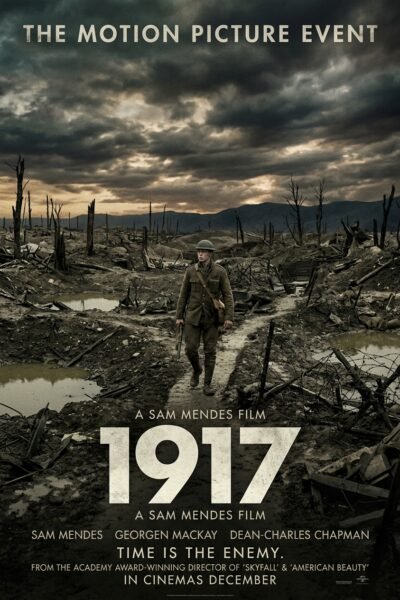
Introduction: A Technical and Emotional Triumph
1917 presents itself as a single, continuous, unbroken shot — a film in which the camera follows Lance Corporals Schofield (George MacKay) and Blake (Dean-Charles Chapman) through the Western Front in real time, never cutting away, never offering the audience the psychological comfort of a scene transition. In reality, it is a series of extraordinarily long takes edited with such precision that the joins are invisible — but the effect is completely achieved. 1917 is one of the most immersive, technically extraordinary, and emotionally devastating war films ever made.
The Mission: Walking Into the Impossible
The premise is elegant and devastating. Blake’s brother is among the 1,600 British soldiers scheduled to attack a German position the following morning — a position that is a trap, the retreating German army having set up a defensive line that will annihilate the advancing troops. Schofield and Blake are given orders to cross no man’s land, penetrate enemy territory, and deliver a message to the commanding officer to cancel the attack. They have until dawn. They have no guarantee of survival. They have each other.
📖 Also Read
-
▶ Mission: Impossible – Dead Reckoning (2023) Review – The Peak of Action Cinema
-
▶ Gladiator (2000) Review – Ridley Scott's Epic That Defined a Generation
-
▶ Inception (2010) Review – Nolan's Dream Architecture That Changed Blockbuster Cinema
-
▶ Spider-Man: No Way Home (2021) Review – Fan Service Elevated to Genuine Cinema
The mission structure gives 1917 both its tension and its emotional logic. We always know exactly what the stakes are — 1,600 lives, including Blake’s brother — and we always understand exactly how much time remains. But the film is not primarily about the mission. It is about the experience of walking through the landscape of a war, step by step, with no ability to see more than a few meters ahead.
Roger Deakins: A Career Peak in a Career of Peaks
Roger Deakins has shot some of the finest films in cinema — No Country for Old Men, Skyfall, Blade Runner 2049, True Grit — but 1917 may be his masterwork. The logistical challenge of shooting extended takes that must maintain continuous visual consistency across changing light conditions, physical environments, and performance requirements is almost incomprehensible. The results are stunning: the trenches shot with claustrophobic precision, the open fields of no man’s land rendered with terrifying exposure, the ruined towns with an eerie, ghostly quality.
The film’s most extraordinary sequence — Schofield running through a burning town at night, illuminated by exploding flares, shadows lurching across ruined walls as he sprints for his life — is one of the most visually spectacular sequences in recent cinema. Deakins composed and executed it as if painting with fire, and the effect is simultaneously beautiful and genuinely horrifying.
George MacKay: Carrying the Film
Schofield is on screen for essentially the entire film, and George MacKay’s performance must sustain the audience’s engagement and emotional investment across two hours of continuous pressure. He does so magnificently — playing a man who is neither a hero in the conventional sense nor a coward, but simply someone trying to survive and complete an impossible task for reasons that gradually reveal themselves to be entirely personal. His final sprint — the film’s climactic sequence — is one of cinema’s great physical performances: desperate, heroic, heartbreaking.
Sam Mendes and Personal History
Sam Mendes has acknowledged that 1917 was inspired by stories his grandfather Alfred Mendes told him about his own experiences in the First World War. This personal connection gives the film an emotional specificity that goes beyond historical recreation. This is not an attempt to capture the War in general — it is an attempt to understand what it felt like to be one person, in one terrible day, trying to do one impossible thing.
Our Rating: ⭐ 9.0 / 10
Verdict: 1917 is a technical marvel and a genuine emotional achievement. It immerses you in the experience of war with an intimacy that no other format could achieve. Essential war cinema and essential filmmaking.
Production Excellence and Technical Achievement
1917 stands as a remarkable achievement in contemporary filmmaking — a film that succeeds not just as entertainment but as a genuine work of cinematic craft. The production team brought together exceptional talent across every department: the cinematography captures each scene with visual intelligence, the production design creates environments that feel authentic and purposeful, and the editing maintains precisely the rhythm the story requires.
The sound design and musical score deserve particular recognition. These sonic elements work in concert with the visual storytelling to create an immersive experience that engages the audience on multiple sensory levels simultaneously. The score, in particular, elevates key sequences beyond what the visuals alone could achieve — creating emotional resonance that persists beyond the specific moments it accompanies.
Themes and Cultural Resonance
What makes 1917 genuinely important rather than merely entertaining is its engagement with themes that extend beyond its immediate narrative. The film asks questions that resonate with contemporary experience: about identity and transformation, about the costs of ambition and the meaning of success, about the relationships between individuals and the communities and institutions that shape them. These themes are not imposed upon the story but emerge naturally from it, which is the mark of genuinely accomplished screenwriting.
The performances throughout are of exceptional quality. The central performance anchors the film with authenticity and emotional intelligence, making the character’s journey feel personally true rather than narratively convenient. The supporting cast creates a fully realized world around that central performance, ensuring that every scene has the texture of genuine human interaction rather than plot mechanics.
Legacy and Recommendation
1917 earns its place among the finest films of its year and its genre. It is the kind of film that reminds audiences why cinema matters — why this particular form of storytelling, with its unique combination of image, sound, performance, and time, can achieve things that no other medium can. It rewards attentive viewing and repays revisitation, revealing new dimensions of craft and meaning with each viewing.
Recommended For: Viewers who appreciate quality filmmaking and emotional authenticity. Best Experienced: With full attention, in the best viewing environment available. This is a film that rewards the investment of genuine engagement.


[…] ▶ 1917 (2019) Review – Sam Mendes' One-Shot WWI Epic Is Pure Cinema […]