
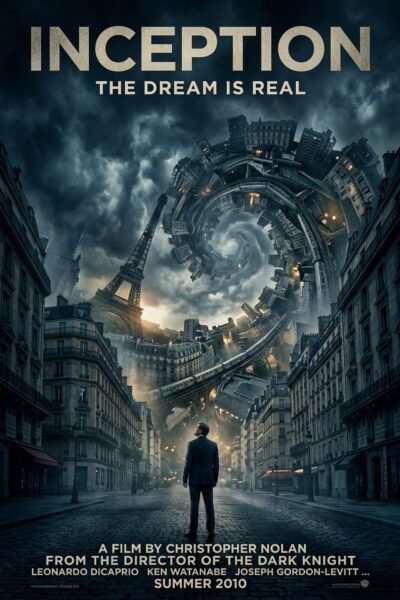
Introduction: The Film That Made Thinking Cool Again
In 2010, Christopher Nolan convinced Warner Bros. to spend $160 million on an original science fiction concept about thieves who steal secrets from people’s dreams, produced the film with no established IP, no franchise connection, and considerable narrative complexity — and it earned $836 million worldwide and became one of the most beloved blockbusters of the 21st century. Inception demonstrated something that the industry needed to be reminded of: audiences will embrace genuine intellectual ambition in mainstream entertainment if the emotional stakes are high enough and the execution brilliant enough.
The Dream Architecture: Rules That Create Stakes
Inception’s central innovation is its internally consistent rule system for dreaming. Dreams have architects who design the environment. The dreamer’s subconscious populates the dream with “projections” that defend against intruders. The deeper you go into dreams-within-dreams, the slower time passes relative to the waking world — ten hours of sleep yield ten-fold time dilation per dream level. A “kick” — a physical falling sensation — jolts the dreamer back up through levels. Limbo — the deepest possible state of dreaming — is a dimension of pure subconscious creation where time passes so slowly that years become subjective centuries.
📖 Also Read
-
▶ Mission: Impossible – Dead Reckoning (2023) Review – The Peak of Action Cinema
-
▶ Gladiator (2000) Review – Ridley Scott's Epic That Defined a Generation
-
▶ 1917 (2019) Review – Sam Mendes' One-Shot WWI Epic Is Pure Cinema
-
▶ Spider-Man: No Way Home (2021) Review – Fan Service Elevated to Genuine Cinema
These rules are elaborate, but Nolan presents them with such clarity and then deploys them with such consistency that they generate genuine narrative stakes. The team’s plan to go three levels deep — a dream within a dream within a dream — has real logical consequences: different timelines running at different speeds, different physical limitations, different risks. The parallel editing in the film’s finale — intercutting between three different dream levels and the van falling in slow motion in the first level — is a masterwork of spatial and temporal storytelling.
DiCaprio’s Cobb: Grief in the Subconscious
Leonardo DiCaprio plays Dominic Cobb, a dream thief haunted by the death of his wife Mal — a death for which he bears direct responsibility, and which has manifested as a projection within every dream he enters, threatening to destroy his missions and expose his guilt. His journey — the desperate need to return to his children, the inability to let go of Mal, the question of whether reality and dream can be reliably distinguished — gives the film’s spectacular architecture its emotional foundation.
The film’s central mystery — is Cobb still dreaming at the end? — remains one of cinema’s great open questions, generating debate that continues today. The spinning top that may or may not fall is so perfectly placed, so deliberately ambiguous, that it functions not as a withholding of information but as an invitation to consider the film’s themes about the constructed nature of reality and the question of whether the distinction between real and dreamed matters if the experience itself is genuine.
Technical Achievement: Shooting the Impossible
Inception is a technical achievement of the highest order. The hotel corridor sequence — in which Arthur (Joseph Gordon-Levitt) fights in a rotating environment while the dreamer below experiences zero gravity — was accomplished with practical sets built on motorized gimbals, requiring weeks of preparation and rehearsal and producing some of the most visually astonishing footage in blockbuster cinema. Wally Pfister’s cinematography is exceptional throughout: the Paris dream sequence that folds in on itself, the snow fortress, the slowly collapsing Limbo cityscape.
Our Rating: ⭐ 9.1 / 10
Verdict: Inception remains a landmark of blockbuster filmmaking — spectacularly entertaining, intellectually stimulating, and emotionally resonant. It rewards rewatching and repays careful analysis. One of the defining films of its decade.
Production Excellence and Technical Achievement
Inception stands as a remarkable achievement in contemporary filmmaking — a film that succeeds not just as entertainment but as a genuine work of cinematic craft. The production team brought together exceptional talent across every department: the cinematography captures each scene with visual intelligence, the production design creates environments that feel authentic and purposeful, and the editing maintains precisely the rhythm the story requires.
The sound design and musical score deserve particular recognition. These sonic elements work in concert with the visual storytelling to create an immersive experience that engages the audience on multiple sensory levels simultaneously. The score, in particular, elevates key sequences beyond what the visuals alone could achieve — creating emotional resonance that persists beyond the specific moments it accompanies.
Themes and Cultural Resonance
What makes Inception genuinely important rather than merely entertaining is its engagement with themes that extend beyond its immediate narrative. The film asks questions that resonate with contemporary experience: about identity and transformation, about the costs of ambition and the meaning of success, about the relationships between individuals and the communities and institutions that shape them. These themes are not imposed upon the story but emerge naturally from it, which is the mark of genuinely accomplished screenwriting.
The performances throughout are of exceptional quality. The central performance anchors the film with authenticity and emotional intelligence, making the character’s journey feel personally true rather than narratively convenient. The supporting cast creates a fully realized world around that central performance, ensuring that every scene has the texture of genuine human interaction rather than plot mechanics.
Legacy and Recommendation
Inception earns its place among the finest films of its year and its genre. It is the kind of film that reminds audiences why cinema matters — why this particular form of storytelling, with its unique combination of image, sound, performance, and time, can achieve things that no other medium can. It rewards attentive viewing and repays revisitation, revealing new dimensions of craft and meaning with each viewing.
Recommended For: Viewers who appreciate quality filmmaking and emotional authenticity. Best Experienced: With full attention, in the best viewing environment available. This is a film that rewards the investment of genuine engagement.



[…] ▶ Inception (2010) Review – Nolan's Dream Architecture That Changed Blockbuster Cinema […]
[…] ▶ Inception (2010) Review – Nolan's Dream Architecture That Changed Blockbuster Cinema […]