
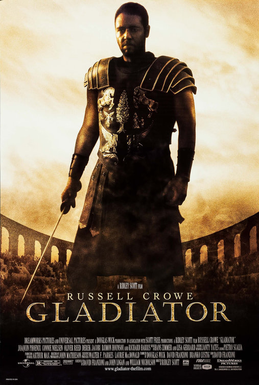
Introduction: The Film That Revived Epic Cinema
In 2000, Gladiator reminded Hollywood and its audiences that ancient world epic storytelling could still generate box office gold and genuine emotional engagement. Ridley Scott’s Roman Empire saga — following the betrayed General Maximus Decimus Meridius from military commander to slave to gladiatorial champion to avenger — won five Academy Awards including Best Picture and Best Actor, and effectively revived a genre that had lain dormant since the 1960s. A quarter-century later, Gladiator remains one of the most viscerally satisfying action epics in cinema history.
Russell Crowe’s Maximus: The Action Era’s Defining Hero
Russell Crowe gives a performance of considerable physical presence and emotional depth as Maximus Decimus Meridius — a man defined by duty, family, and a specific kind of Roman virtue that the film treats with complete sincerity. What could easily be a one-dimensional revenge fantasy is elevated by Crowe’s intelligence and his careful attention to the character’s specific grief. Maximus is not primarily motivated by revenge in the abstract — he is motivated by the specific, irreparable loss of his wife and son, whose deaths he witnesses in flashback with a frequency that communicates how completely they define his psychological landscape.
📖 Also Read
-
▶ 1917 (2019) Review – Sam Mendes' One-Shot WWI Epic Is Pure Cinema
-
▶ Inception (2010) Review – Nolan's Dream Architecture That Changed Blockbuster Cinema
-
▶ Mission: Impossible – Dead Reckoning (2023) Review – The Peak of Action Cinema
-
▶ Spider-Man: No Way Home (2021) Review – Fan Service Elevated to Genuine Cinema
Crowe communicates power with minimal effort — the physicality is impressive but never cartoonish, and his eyes convey the internal life of a man who has decided what he will do and accepted the cost. His performance in the film’s quieter moments — his grief, his relationship with his fellow gladiators, his private moments of prayer at the small shrine of his family’s miniatures — is as effective as his presence in the combat sequences.
Joaquin Phoenix’s Commodus: Shakespearean Villainy
Joaquin Phoenix was twenty-five years old when he played Commodus, the insecure, murderous Roman emperor who orders Maximus’s death and becomes his ultimate antagonist. It is a performance of extraordinary malice and psychological complexity: Commodus is not simply cruel but wounded, a man whose monstrous behavior is the distorted expression of a profound need for love and approval that his father withheld. The film’s most disturbing moment — Commodus’s near-incestuous declaration to his sister of what he needs from her — reveals a character whose villainy is rooted in something genuinely pathetic and recognizable.
Ridley Scott’s Direction: Epic Scale with Human Stakes
Scott approached Gladiator with the visual grandeur of his best work — his attention to the physical texture of historical environments, his instinct for the staging of large-scale action sequences, and his ability to maintain human scale within massive setpieces. The opening battle sequence — the Roman legions attacking the Germanic tribes in a forest at dawn — is still one of cinema’s great action openings: chaotic, visceral, and organized with enough visual clarity that the geography of the battle remains legible throughout.
The Colosseum sequences are equally accomplished. Scott renders the arena as a genuine spectacle — the roar of 30,000 Romans, the sand and the blood, the mechanical ingenuity of the gladiatorial entertainment — while keeping the focus on Maximus and the human stakes of his survival. The famous “Are you not entertained?” moment works because Crowe has made us feel the absurdity and degradation of the situation — a great general reduced to performing for a crowd.
Hans Zimmer and Lisa Gerrard’s Score
The score for Gladiator — a collaboration between Hans Zimmer and vocalist Lisa Gerrard — is one of cinema’s great achievements in film music. Gerrard’s wordless vocal performances give the film a keening, ancient quality that no conventional orchestral score could have achieved. “Now We Are Free,” which plays over the film’s conclusion, is one of cinema’s most emotionally devastating musical moments: a sound of loss and release simultaneously, of a man who has finally earned his rest.
Our Rating: ⭐ 8.9 / 10
Verdict: Gladiator is spectacular, emotionally satisfying epic cinema that has not lost a frame of its power in twenty-five years. Essential viewing for fans of historical epic filmmaking and anyone who appreciates great screen performances.
Production Excellence and Technical Achievement
Gladiator stands as a remarkable achievement in contemporary filmmaking — a film that succeeds not just as entertainment but as a genuine work of cinematic craft. The production team brought together exceptional talent across every department: the cinematography captures each scene with visual intelligence, the production design creates environments that feel authentic and purposeful, and the editing maintains precisely the rhythm the story requires.
The sound design and musical score deserve particular recognition. These sonic elements work in concert with the visual storytelling to create an immersive experience that engages the audience on multiple sensory levels simultaneously. The score, in particular, elevates key sequences beyond what the visuals alone could achieve — creating emotional resonance that persists beyond the specific moments it accompanies.
Themes and Cultural Resonance
What makes Gladiator genuinely important rather than merely entertaining is its engagement with themes that extend beyond its immediate narrative. The film asks questions that resonate with contemporary experience: about identity and transformation, about the costs of ambition and the meaning of success, about the relationships between individuals and the communities and institutions that shape them. These themes are not imposed upon the story but emerge naturally from it, which is the mark of genuinely accomplished screenwriting.
The performances throughout are of exceptional quality. The central performance anchors the film with authenticity and emotional intelligence, making the character’s journey feel personally true rather than narratively convenient. The supporting cast creates a fully realized world around that central performance, ensuring that every scene has the texture of genuine human interaction rather than plot mechanics.
Legacy and Recommendation
Gladiator earns its place among the finest films of its year and its genre. It is the kind of film that reminds audiences why cinema matters — why this particular form of storytelling, with its unique combination of image, sound, performance, and time, can achieve things that no other medium can. It rewards attentive viewing and repays revisitation, revealing new dimensions of craft and meaning with each viewing.
Recommended For: Viewers who appreciate quality filmmaking and emotional authenticity. Best Experienced: With full attention, in the best viewing environment available. This is a film that rewards the investment of genuine engagement.




[…] ▶ Gladiator (2000) Review – Ridley Scott's Epic That Defined a Generation […]