
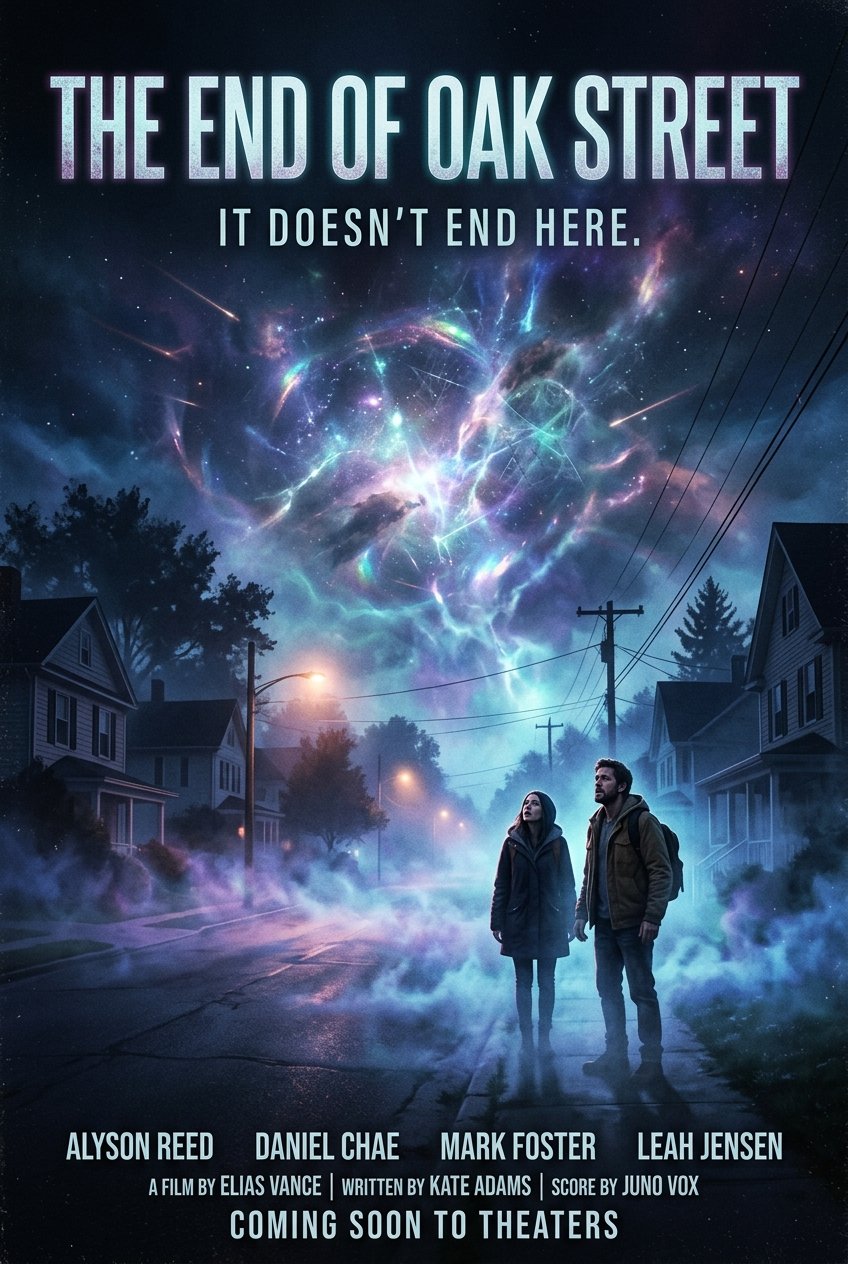
| Director | David Robert Mitchell |
|---|---|
| Cast | Anne Hathaway, Ewan McGregor, Maisy Stella, Christian Convery, Kyle MacLachlan |
| Release Date | August 14, 2026 |
| Genre | Sci-Fi / Mystery / Psychological Thriller |
| Runtime | 124 minutes |
| Studio | Warner Bros. Pictures / Bad Robot |
| Our Rating | 8.4 / 10 |
Anne Hathaway and Ewan McGregor Star in David Robert Mitchell Mind-Bending Sci-Fi
Director David Robert Mitchell, acclaimed for his groundbreaking horror masterpiece It Follows and surreal noir puzzle Under the Silver Lake, returns to cinemas with The End of Oak Street (2026). Starring Academy Award winner Anne Hathaway and Ewan McGregor, this taut, atmospheric sci-fi thriller explores suburban paranoia, temporal anomalies, and cosmic dread with hypnotic visual precision.
The Mystery of the Oak Street Anomaly
Set in a quiet, picturesque American suburban cul-de-sac during a sweltering August, the film opens as residents of Oak Street notice subtle, unsettling occurrences: digital clocks skipping minutes, shadows moving opposite light sources, and pets reacting to invisible presences. Ellen (Anne Hathaway) and her husband Mark (Ewan McGregor) initially dismiss these events as electrical glitches caused by a local power grid upgrade.
However, when a dense, shimmering electromagnetic fog rolls over the edges of Oak Street, sealing off the neighborhood from the outside world, the residents discover that their street has become detached from normal space-time, looping back into itself every time someone attempts to walk past house number 104.
Star Performances and Psychological Tension
Anne Hathaway delivers a riveting performance as Ellen, a mother striving to protect her teenage daughter while methodically recording the environmental changes taking place around their home. Ewan McGregor provides strong emotional grounding as Mark, whose rational engineering mind slowly unravels under the pressure of impossible physical phenomena.
Maisy Stella shines as their observant daughter Chloe, whose home video camera captures impossible temporal overlaps, while Kyle MacLachlan offers an unsettling supporting turn as an eccentric neighborhood watch coordinator attempting to maintain suburban order under apocalyptic circumstances.
The film excels in constructing psychological dread without relying on cheap jump scares. Mitchell uses slow, 360-degree panning shots down Oak Street tree-lined sidewalks to evoke a profound sense of claustrophobia and isolation despite the bright afternoon sunshine.
Sociological Paranoia in American Suburbia
Beyond its sci-fi high concept, The End of Oak Street operates as a brilliant social satire on suburban conformity and neighborly distrust. As resources dwindle and the temporal loop tightens, the pristine manicured lawns of Oak Street transform into a pressure cooker of suspicion. Neighbors who once exchanged polite pleasantries begin hoarding supplies, building makeshift barricades, and accusing one another of triggering the anomaly.
Hathaway character serves as the moral voice amidst growing mob hysteria, highlighting how quickly social etiquette fractures when existential fear takes hold of a community. Mitchell balances the psychological breakdown of the neighborhood with genuine moments of human empathy.
Philosophical Underpinnings and Ending Breakdown
Thematically, Mitchell uses the spatial looping of Oak Street to critique human denial. The characters spend days attempting to escape geographically when the true solution requires confronting past emotional trauma buried within their suburban community. The climax presents a breathtaking visual sequence where house structures disassemble in reverse gravity, offering a lingering, thought-provoking conclusion that rewards multiple viewings.
Cinematography, Visual Aesthetics, and Sound Engineering
Cinematographer Mike Gioulakis captures suburban domesticity with eerie, hyper-clean framing. The wide anamorphic lenses make every familiar suburban element — sprinkler systems, mailboxes, asphalt streets — feel alien and ominous. The visual palette shifts gradually from sunny pastels to desaturated, twilight blues as the anomaly intensifies.
The sound design is extraordinary, using low-frequency binaural hums, reversing ambient bird calls, and subtle audio distortions to signal shifts in temporal reality. The score by Disasterpeace amplifies the uncanny atmosphere with minimalist synthesizer textures, creating an auditory experience that gets under the viewer skin.
Critical Reception and Cultural Impact
Critics have lauded The End of Oak Street as one of the standout sci-fi features of 2026, comparing its tense atmosphere to Rod Serling The Twilight Zone, Denis Villeneuve Arrival, and Steven Spielberg early suburban masterpieces. Its unique blend of quiet emotional character drama and mind-bending physics guarantees its status as a future cult classic.
What Works
- Anne Hathaway and Ewan McGregor compelling, emotionally resonant lead performances
- David Robert Mitchell masterclass in suburban paranoia and atmospheric dread
- Hypnotic 360-degree cinematography and Disasterpeace eerie synth score
- Intriguing sci-fi premise exploring temporal loops and cosmic isolation
- Strong tension building without relying on conventional monster jump scares
- Provocative ending that sparks extensive post-viewing discussion
Minor Criticisms
- Deliberately enigmatic ending may leave casual viewers seeking explicit answers divided
- Deliberate, slow-burn pacing in the opening thirty minutes
Thematic Deep Dive: Suburban Isolation and Temporal Metaphors
David Robert Mitchell storytelling is distinguished by its refusal to offer simplistic answers. In The End of Oak Street, the temporal anomaly is not merely a scientific anomaly — it serves as an allegory for modern societal fragmentation. Each household on Oak Street represents a different coping mechanism: denial, violent paranoia, religious fatalism, and scientific obsession. As the electromagnetic barrier closes in, Mitchell illustrates how easily civil society crumbles when individuals prioritize self-preservation over communal solidarity.
The cinematography by Mike Gioulakis enhances this thematic subtext by using static, symmetrical framing that slowly becomes unbalanced as the characters mental stability deteriorates. The film stands as one of the most intellectually rewarding sci-fi experiences of the decade.
Frequently Asked Questions (FAQ)
Q: Is The End of Oak Street based on a book?
A: No, the film is an original screenplay written and directed by David Robert Mitchell.
Q: Who composed the soundtrack for The End of Oak Street?
A: The electronic score was composed by Disasterpeace (Rich Vreeland), who previously scored It Follows.
Q: What is the age rating for the film?
A: It is rated PG-13 for intense sci-fi terror, thematic elements, and brief language.
Final Verdict
The End of Oak Street is a sophisticated, haunting sci-fi thriller that cements David Robert Mitchell as one of modern cinema most distinctive visual stylists. Highly recommended for fans of psychological sci-fi.
MovieOn Rating: 8.4 / 10

Leave a Reply