
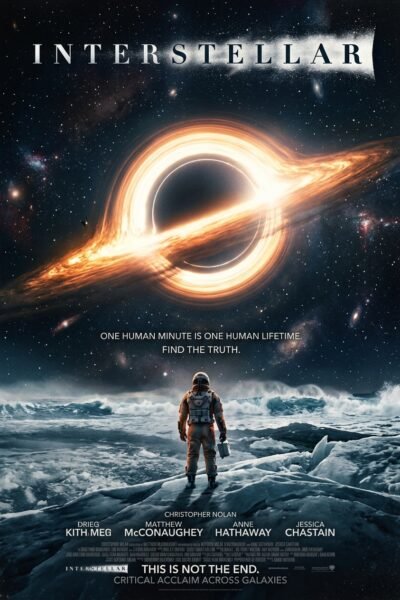
Introduction & Sci-Fi Ambition
Christopher Nolan’s 2014 sci-fi epic Interstellar represents a breathtaking convergence of theoretical astrophysics and human emotion. Following in the footsteps of Stanley Kubrick’s 2001: A Space Odyssey, Interstellar dares to ask massive questions about human survival, gravity, time dilation, and the mysteries of deep space. Anchored by scientific consultation from Nobel laureate physicist Kip Thorne, the film balances hard scientific realism with a deeply personal story about a father’s love for his daughter.
Plot & Global Extinction Narrative
In a dystopian near-future, Earth is dying. A global blight has ruined crops, leaving humanity facing slow starvation. Joseph Cooper (Matthew McConaughey), a former NASA pilot turned farmer, discovers gravitational anomalies in his daughter Murph’s bedroom that lead him to a secret underground NASA facility. Led by Professor Brand (Michael Caine), scientists have discovered a wormhole near Saturn placed by mysterious futuristic beings. Cooper is recruited to pilot the Endurance spacecraft alongside Dr. Amelia Brand (Anne Hathaway), Doyle (Wes Bentley), and Romilly (David Gyasi) to explore three potential habitable planets in another galaxy.
📖 Also Read
-
▶ Avatar: The Way of Water (2022) Review – James Cameron's Visual Masterpiece
-
▶ Dune: Part Two (2024) In-Depth Movie Review – Denis Villeneuve’s Sci-Fi Masterpiece
-
▶ Disclosure Day (2026) – Steven Spielberg’s Optimistic Sci-Fi Drama Starring Emily Blunt
-
▶ The Zone of Interest (2023) Review – A Holocaust Film Unlike Any Other
The Physics of Time Dilation & Cosmic Visuals
One of Interstellar’s greatest achievements is its terrifyingly realistic depiction of general relativity and time dilation. The expedition to Miller’s planet—a world orbiting dangerously close to the supermassive black hole Gargantua—demonstrates that 1 hour on the planet equals 7 Earth years. The sequence is heart-pounding, culminating in massive tidal waves and a devastating return to the ship where 23 years have passed in minutes.
Visual effects supervisor Paul Franklin and DNEG collaborated with Kip Thorne to create the first accurate computer simulation of a black hole’s gravitational lensing. The resulting visual of Gargantua—a glowing ring of light bent around a pitch-black abyss—was so accurate it led to real scientific papers being published.
Emotional Performances
Matthew McConaughey delivers an extraordinarily moving performance as Cooper. His breakdown while watching 23 years of missed video messages from his growing children is one of the most heartbreaking acting moments in modern cinema. Mackenzie Foy and Jessica Chastain both excel as young and adult Murph, embodying the grief and determination of a daughter abandoned by her father for the sake of humanity’s survival.
Hans Zimmer’s Pipe Organ Score
Hans Zimmer broke away from his traditional percussion-heavy action scores to create a haunting, spiritual soundtrack centered around a 1926 Harrison & Harrison pipe organ at Temple Church in London. The breathing mechanism of the organ symbolizes the fragile breath of human life in the vacuum of space. Tracks like “Cornfield Chase” and “No Time for Caution” (which accompanies the legendary docking scene) are modern musical triumphs.
Themes of Love Across Dimensions
While rooted in hard science, Interstellar boldly argues that love is a quantifiable force capable of transcending dimensions of time and space. The climax inside the Tesseract—a 5-dimensional construction rendered in 3-dimensional space—allows Cooper to communicate across time to Murph via gravity, demonstrating that human connection is humanity’s ultimate survival tool.
Final Verdict
Christopher Nolan’s Interstellar is an emotionally resonant science fiction masterpiece. With unforgettable visuals, mind-bending scientific accuracy, and Hans Zimmer’s magnificent score, it remains a triumphant celebration of human curiosity and eternal love.
The Docking Sequence: Tension Without Artifice
One of Interstellar’s great sequences is the docking of the Ranger with the spinning Endurance — a sequence that achieves genuine tension through physical and mechanical specificity rather than conventional action movie shortcuts. The problem is clearly defined, the stakes are clear, the attempted solutions are logical, and the failure and eventual success are grounded in the physics of the situation. Hans Zimmer’s “No Time for Caution” — which rises to almost unbearable intensity over the sequence — is a perfect example of film music doing what it does best: amplifying emotional stakes through sound.
The Video Messages: Time Dilation Made Human
The sequence in which Cooper watches years of video messages from his children after returning from Miller’s planet — messages that accumulated while an hour of his time cost them seven years of theirs — is Interstellar’s most emotionally devastating scene, and one of the most powerful sequences in science fiction cinema. Matthew McConaughey watches his son age from a child into a man, watches his daughter’s anger harden into something that looks like abandonment, watches decades of his children’s lives that he will never share — all while sitting in the same relative moment he left. The performance requires conveying an emotional weight that is genuinely almost unimaginable, and McConaughey delivers it with heartbreaking completeness.
Murphy’s Law: The Daughter’s Perspective
Jessica Chastain’s adult Murph — working to solve Professor Brand’s gravity equation from the same NASA facility where her father trained — is the film’s other emotional center, and her arc complements Cooper’s with elegant symmetry. While Cooper journeys outward into space and time, Murph journeys inward into the scientific problem that could save humanity. Her anger at her father’s departure, her eventual understanding of what it cost him, and her climactic breakthrough are all handled with the emotional intelligence that the film consistently demonstrates.
Why Interstellar Endures
A decade after its release, Interstellar has grown rather than shrunk in public estimation. Its scientific accuracy — validated by the Event Horizon Telescope’s 2019 black hole image, which matched the film’s simulation remarkably closely — gives it a resonance that purely fantastical science fiction cannot claim. Its emotional honesty — the genuine ache of its father-daughter relationship, the real cost of its sacrifice — gives it a human weight that persists beyond the spectacle. And its fundamental optimism — its belief that love is the most powerful force in the universe, not despite being unquantifiable but because of it — speaks to something fundamental about why we tell stories at all.




[…] ▶ Interstellar (2014) Retrospective Review – Science, Time & Human Connection […]