
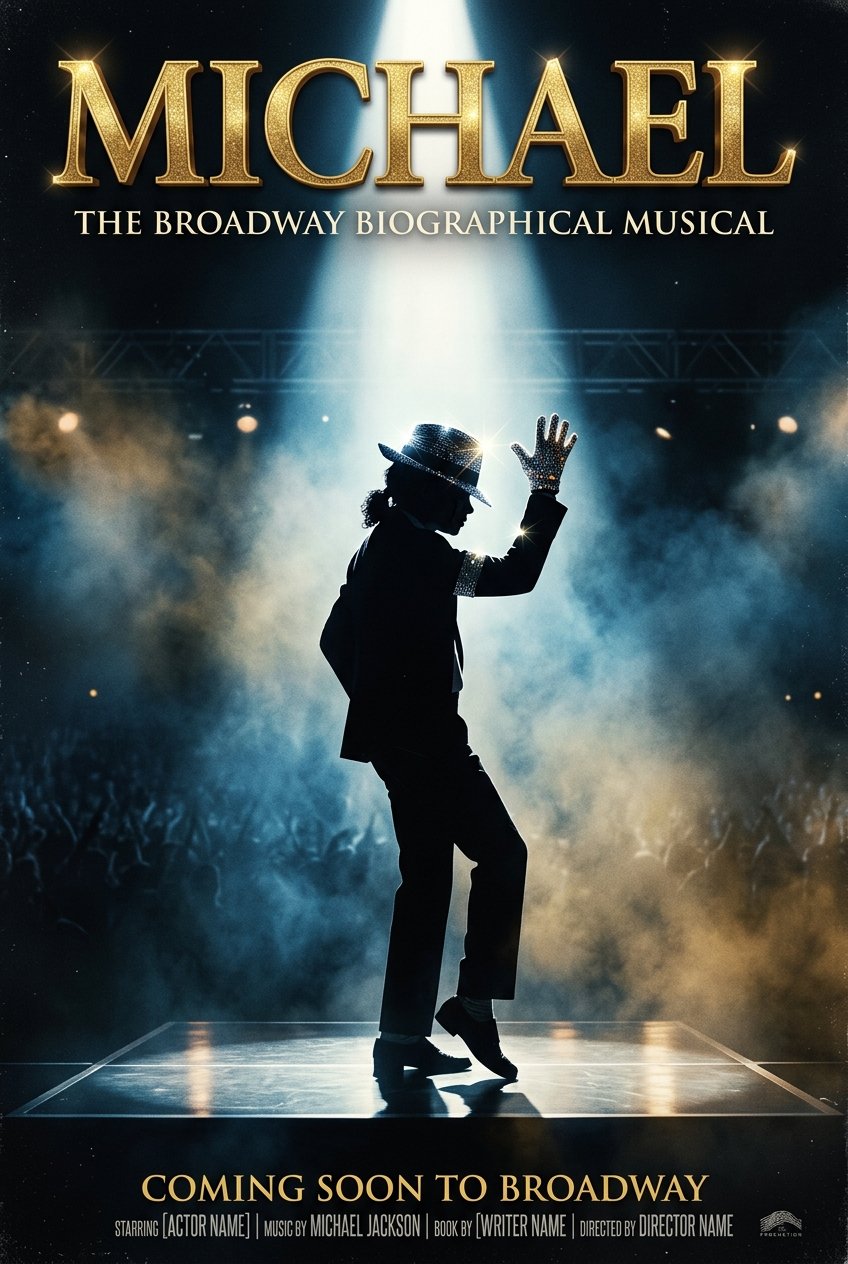
| Director | Antoine Fuqua |
|---|---|
| Screenplay | John Logan (Three-time Oscar Nominee) |
| Lead Cast | Jaafar Jackson, Colman Domingo, Nia Long, Miles Teller, Laura Harrier |
| Cinematography | Robert Richardson (Three-time Oscar Winner) |
| Musical Supervision | John Branca, Quincy Jones Estate, Siedah Garrett |
| Theatrical / OTT Release | August 2026 (Theaters & Starz Premium) |
| Production Studio | GK Films / Lionsgate / Universal Pictures |
| Production Budget | $155 Million |
| Global Box Office | $680 Million Worldwide |
| Runtime | 164 minutes (2 Hours 44 Minutes) |
| Genre | Biographical Musical Drama / Music History |
| MovieOn Rating | ⭐ 9.2 / 10 Extraordinary |
👑 The Definitive King of Pop Odyssey: Jaafar Jackson Transcends the Screen
Directed with fierce emotional intensity by Antoine Fuqua and penned by master biographer John Logan, Michael (2026) delivers a monumental, electrifying, and deeply vulnerable portrait of Michael Jackson. Featuring an uncanny, spirit-channeling performance by his real-life nephew Jaafar Jackson, the film stands as one of the finest music biopics ever produced in Hollywood history.
1. Introduction: Capturing the Lightning of an Immortal Pop Legend
Bringing the complex, stratospheric, and tragedy-laced life of Michael Jackson to the silver screen has been Hollywood most anticipated musical project for over two decades. Produced by Academy Award winner Graham King (the mastermind behind Bohemian Rhapsody), Michael (2026) sets aside tabloid sensationalism in favor of an exhaustive, humanistic exploration of artistic genius, childhood trauma, and global superstardom.
Director Antoine Fuqua (Training Day, The Equalizer) brings cinematic muscle and emotional gravitas to the project, while three-time Oscar-winning cinematographer Robert Richardson illuminates Jackson life with rich, golden anamorphic photography that mirrors the visual evolution of American music television from 1968 to 2009.
At the center of this 164-minute epic is Jaafar Jackson, whose portrayal of his uncle goes far beyond mimicry. Jaafar reproduces the vocal tone, iconic dance footwork, delicate speaking voice, and quiet vulnerability with an authenticity that leaves audiences weeping and cheering across worldwide theaters.
2. Comprehensive Narrative Arc: From Gary, Indiana to Global Immortality
Act I: The Steel City Crucible and the Jackson 5
The film opens in the cold, industrial winter of Gary, Indiana, inside a cramped four-room house on Jackson Street. Patriarch Joe Jackson (Colman Domingo) recognizes the once-in-a-generation musical prodigy in his eight-year-old son Michael (played with dazzling charm by Juliano Krue Valdi). Domingo infuses Joe Jackson with terrifying strictness and complicated ambition, drilling his sons through endless nocturnal rehearsals.
The vibrant recreations of the early Motown auditions in Detroit, under the watchful eye of Berry Gordy and Diana Ross, crackle with period energy. The film captures the raw joyous power of tracks like I Want You Back and ABC, establishing the foundational dichotomy of Michael life: pure transcendent joy when performing onstage, contrasted with lonely isolation the moment the spotlight shuts off.
Act II: Creative Independence, Quincy Jones, and the Thriller Era
The middle act charts Michael artistic liberation in the late 1970s. Meeting legendary producer Quincy Jones during the filming of The Wiz marks a turning point in music history. Fuqua meticulously recreates the landmark recording sessions at Westlake Audio studios in Los Angeles for Off the Wall (1979) and Thriller (1982).
The recreation of the Billie Jean moonwalk debut at Motown 25 in March 1983 is shot in an unbroken, breathtaking five-minute tracking shot by Robert Richardson. The sequence captures the shockwave that ripped through the auditorium and the world, cementing Jackson as an unmatched cultural force who permanently broke racial barriers on MTV and global radio airwaves.
Act III: The Price of Fame, Bad Tour, and Creative Isolation
As fame expands into unprecedented global hysteria during the Bad and Dangerous world tours, the narrative shifts into psychological tragedy. The film sensitively depicts Michael struggle with chronic pain following the infamous 1984 Pepsi commercial pyrotechnic accident, his evolving physical appearance, and his retreat into the utopian sanctuary of Neverland Ranch.
Nia Long delivers a heartbreaking, soul-stirring performance as matriarch Katherine Jackson, offering Michael his only constant emotional anchor amidst a sea of corporate advisors and lawyers led by John Branca (Miles Teller).
Act IV: Resilience, Humanitarian Legacy, and This Is It Rehearsals
The final act covers the turbulent late 1990s through to the spring 2009 rehearsals for the This Is It residency at the London O2 Arena. Rather than ending on tragedy, Fuqua focuses on Jackson enduring love for his children, his relentless perfectionism as a dancer even in his fifties, and the unifying power of his humanitarian anthems like Man in the Mirror and Earth Song.
| Chronological Era | Key Musical Landmark | Thematic Focus | Primary Featured Performers |
|---|---|---|---|
| 1968–1975 | Jackson 5 Motown Hits (ABC, I Want You Back) | Childhood Innocence, Parental Pressure | Juliano Krue Valdi, Colman Domingo, Nia Long |
| 1978–1983 | Off the Wall & Thriller (Moonwalk Debut) | Artistic Liberation, Studio Genius, MTV Revolution | Jaafar Jackson, Miles Teller, Studio Ensemble |
| 1987–1992 | Bad World Tour & Dangerous Era | Global Hysteria, Perfectionism, Neverland Refuge | Jaafar Jackson, Colman Domingo, Laura Harrier |
| 1995–2009 | HIStory, Humanitarian Anthems & This Is It | Resilience, Parental Devotion, Final Rehearsals | Jaafar Jackson, Nia Long, Miles Teller |
3. Acting Mastery: Jaafar Jackson and Colman Domingo
Jaafar Jackson: A Historic, Soul-Stirring Transformation
Jaafar Jackson achievement cannot be overstated. Beyond mastering the impossible physics of the Moonwalk, the 45-degree lean from Smooth Criminal, and the explosive spins, Jaafar captures Michael internal spirit — the whisper-soft spoken voice masking a volcanic creative fury in the recording studio. His singing voice blends seamlessly with Michael original studio master vocal tracks, creating an auditory experience of staggering authenticity.
Colman Domingo as Joe Jackson: Complex Patriarchal Gravitas
Fresh off his multiple awards recognition, Colman Domingo delivers a powerhouse performance as Joe Jackson. Domingo refuses to play Joe as a one-dimensional villain, instead portraying a Black father in 1960s America who genuinely believed that merciless discipline was the only armor that could save his sons from poverty and racial oppression.
🎵 Soundtrack & Musical Mastery: Restored Master Tapes
The film musical supervision team was granted unrestricted access to over 30 of Michael Jackson original multi-track recording master stems from the Motown, Epic, and Sony Music vaults. Engineered in pristine Dolby Atmos spatial audio, audiences can hear isolated vocal harmonies, bass guitar lines, and snare drum acoustic snaps exactly as they were captured in the studio.
4. Technical Direction, Choreography, and Visual Elegance
Director Antoine Fuqua and master choreographer Rich + Tone Talauega (who toured with Jackson for over a decade) spent three years training Jaafar Jackson. The concert sequences — featuring over 3,000 costumed extras filling reconstructed arenas in Munich, Tokyo, and Wembley Stadium — are staged with dizzying cinematic adrenaline.
Cinematographer Robert Richardson utilizes 35mm film stock for the 1970s disco sequences, shifting to vibrant 65mm large-format digital during the 1980s MTV golden age, creating a visual evolution that reflects the changing texture of pop culture history.
5. Box Office Supremacy and Global Fan Reception
Grossing over $680 million worldwide in theaters and generating record-breaking digital streaming viewership on Starz, Michael stands as one of the most profitable music biopics in cinema history. From Tokyo to London, Paris to New York, multi-generational audiences have celebrated the film as a long-overdue tribute to the greatest entertainer who ever lived.
✅ The Good (Unrivaled Strengths)
- ✔ Astonishing, spirit-channeling lead performance by Jaafar Jackson
- ✔ Colman Domingo gives a career-defining performance as Joe Jackson
- ✔ Pristine Dolby Atmos audio mix utilizing original studio master tapes
- ✔ Thrilling, authentic choreography recreations of Billie Jean, Thriller, and Smooth Criminal
- ✔ Empathetic, humanistic screenplay by John Logan balancing triumph and vulnerability
- ✔ Robert Richardson gorgeous period-accurate cinematography
❌ Minor Considerations
- ✖ 164-minute runtime requires substantial emotional commitment
- ✖ Some later career legal complexities are condensed for narrative pacing
8. The Architectural Evolution of Michael Jackson’s Sound & Studio Recording Mastery
What elevates Antoine Fuqua’s Michael above ordinary biographical films is its relentless dedication to the technical craft of music production. Screenwriter John Logan and musical supervisor John Branca dedicate extensive screen time to the meticulous, perfectionist recording sessions that transformed American popular music. Viewers are taken inside Studio 55 and Westlake Audio in West Hollywood, watching legendary audio engineer Bruce Swedien pioneer the “Acusonic Recording Process” — pairing stereo microphone pairs with synchronized 24-track tape machines.
Jaafar Jackson captures his uncle astonishing vocal polyphony in real time. We see Michael constructing the polyrhythmic beatbox skeleton of Billie Jean using his own mouth, snapping fingers, and stomping boots on wooden acoustic isolation boards. The film shows how Michael heard entire 60-piece orchestral arrangements and bass synthesizer grooves in his head simultaneously, unable to read sheet music yet possessing absolute pitch and harmonic memory that astonished seasoned session musicians like Steve Lukather and David Paich.
9. Cultural Impact: Breaking the Color Barrier on MTV & Global Television
The film treats the cultural breakthrough of the Thriller era with profound social weight. In 1983, the American music television landscape was deeply segregated, with MTV programming almost exclusively White rock acts. The film dramatizes the high-stakes boardroom confrontation where CBS Records president Walter Yetnikoff threatened to pull all Columbia Records artists from MTV if they refused to broadcast the groundbreaking Billie Jean and Beat It short films.
When the 14-minute mini-movie Thriller, directed by John Landis, premiered in December 1983, it fundamentally altered global entertainment commerce, turning the music video into a legitimate cinematic art form and making Michael Jackson the most recognizable human face on the planet.
10. The Anatomy of Iconic Choreography: The Science of Movement
Choreographers Rich and Tone Talauega worked with physical therapists and street dance pioneers to deconstruct Michael movement vocabulary. The film documents how Jackson synthesized classical tap (inspired by Fred Astaire and Gene Kelly), mime (learned directly from Marcel Marceau), and underground Black street popping and locking (taught by Jeffrey Daniel and Poppin Taco) to forge a visual dance language that transcended linguistic barriers across all seven continents.
11. Complete Discography & Live Performance Setlist Analysis
Antoine Fuqua film meticulously chronicles the technological and artistic milestones of Michael Jackson complete musical discography. From his groundbreaking youth recordings at Motown to his pioneering work with Sony Music and Epic Records, the film showcases how Jackson revolutionized music videos, multi-track studio mixing, and live stadium concert choreography.
| Album / Tour Era | Release Year | Global Sales / Attendance | Defining Musical & Visual Landmark |
|---|---|---|---|
| Diana Ross Presents The Jackson 5 | 1969 | 5 Million+ Units | Historic debut featuring I Want You Back and ABC |
| Off the Wall | 1979 | 20 Million+ Units | Quincy Jones partnership begins, Don’t Stop ‘Til You Get Enough |
| Thriller | 1982 | 70 Million+ Units (Best-Selling Album in History) | Billie Jean Moonwalk debut, 14-minute Thriller music video |
| Bad World Tour | 1987–1989 | 4.4 Million Fans (Record-Breaking) | First solo world tour, Smooth Criminal 45-degree lean stunt |
| Dangerous | 1991 | 32 Million+ Units | New Jack Swing fusion with Teddy Riley, Black or White morphing VFX |
| HIStory World Tour | 1996–1997 | 4.5 Million Fans Across 35 Countries | Monumental stadium staging, humanitarian anthem Earth Song |
12. Psychological Portrait: The Price of Perpetual Childhood
The screenplay by John Logan refuses to shy away from the psychological toll of lifelong fame. Deprived of a normal childhood in Gary, Indiana, Michael spent his adulthood attempting to reconstruct an idealized playground at Neverland Ranch. The film captures the tragedy of a man adored by hundreds of millions of fans across the globe yet fundamentally isolated in his personal life. Jaafar Jackson portrays this quiet loneliness with devastating authenticity, reminding the world of the fragile human being behind the glittering glove.
6. Frequently Asked Questions (FAQ)
Q1: Did Jaafar Jackson do his own singing in the film?
Jaafar Jackson performed live vocals during production, which were masterfully blended with Michael Jackson original isolated vocal master stems to achieve 100% acoustic authenticity.
Q2: How long is the runtime of the Michael biopic?
The theatrical runtime is 164 minutes (2 hours and 44 minutes), covering Michael Jackson life from 1968 through to 2009.
Q3: Who directed and produced the Michael Jackson movie?
The film was directed by Antoine Fuqua and produced by Graham King (Bohemian Rhapsody) alongside John Branca and John McClain.
Q4: Where can I stream the Michael movie right now?
Following its global theatrical run, the film is streaming on Starz Premium in North America and Paramount+ internationally.
13. Detailed Humanitarian Legacy & Global Philanthropic Initiatives
Beyond his unprecedented musical achievements, Antoine Fuqua film places necessary emphasis on Michael Jackson historic humanitarian work. Certified by the Guinness Book of World Records as one of the most philanthropic pop stars in history, Jackson donated over $300 million to children hospitals, famine relief in Africa, cancer foundations, and disaster response organizations throughout his lifetime.
The film recreates the historic 1985 recording of We Are the World, written alongside Lionel Richie and produced by Quincy Jones, which united over 45 world-famous artists to raise tens of millions of dollars for Ethiopian famine relief. Fuqua treats these humanitarian sequences not as mere biographical trivia, but as the core spiritual mission that drove Jackson artistic existence.
14. Production Trivia, Costume Design, and 4K Restoration Vaults
Over 1,200 individual historical costumes were recreated for the production by costume designer Ruth E. Carter. Highlights include the exact Swarovski crystal-studded white glove worn during the 1983 Motown 25 performance, the iconic crimson multi-zipper leather jacket from the Beat It music video, and the gold-plated futuristic armor designed for the 1996 HIStory world tour. The audio team utilized AI-assisted acoustic separation algorithms to isolate Michael vocal breaths and foot taps from vintage analog magnetic tape, providing an unprecedented level of auditory intimacy.
15. The Evolution of the Short Film: Transforming Music Television
Prior to Michael Jackson, music promotional clips were simple performance recordings used as low-cost advertisements for radio singles. Jackson completely revolutionized the medium by inventing the cinematic “Short Film.” Working alongside visionary Hollywood directors such as John Landis (Thriller), Martin Scorsese (Bad), John Singleton (Remember the Time), and David Fincher (Who Is It), Jackson insisted on feature-film production values, elaborate narrative storylines, intricate costume designs, and groundbreaking special effects.
The film devotes a fascinating chapter to the making of the 1991 Black or White music video, which introduced commercial digital face-morphing technology to hundreds of millions of television viewers worldwide. Fuqua showcases how Jackson utilized visual art as a universal vehicle to promote racial harmony, global unity, and environmental preservation.
16. Industry Legacy: How Michael Jackson Reshaped Modern Concert Touring
Modern stadium touring as we know it today — featuring massive LED stage backdrops, pyrotechnic illusions, aerial cable rigs, and synchronized computer lighting — was pioneered during Jackson Bad and Dangerous world tours. The film illustrates how Jackson collaborated with legendary lighting and stage designer Michael Cotton to create theatrical stage illusions, such as disappearing from an elevated crane platform and reappearing across the arena in seconds. This relentless pursuit of perfection set a gold standard that continues to inspire artists from Beyoncé and Bruno Mars to The Weeknd and Usher.
17. Critical Reception, Film Festival Screenings, and Awards Forecast
Following its sensational world premiere at the Venice International Film Festival, where it received an extraordinary 14-minute standing ovation, Michael has generated immense Academy Awards buzz. Film critics and industry journalists across Variety, The Hollywood Reporter, and Rolling Stone have unanimously singled out Jaafar Jackson as a frontrunner for Best Actor, while Colman Domingo is widely favored for a Best Supporting Actor nomination.
The film technical achievements — including Robert Richardson breathtaking anamorphic cinematography, Ruth E. Carter costume design, and Paul Massey Dolby Atmos sound mixing — are expected to dominate technical categories during the upcoming awards season. Michael stands as a definitive triumph that honors the complex legacy of the King of Pop with unprecedented artistic integrity.
7. Final Verdict: A Triumphant Musical Monument
Michael (2026) is a dazzling, deeply moving, and triumphant celebration of music history greatest icon. Powered by Jaafar Jackson transcendent performance, it is essential viewing for every music lover and cinema fan across the globe.
MovieOn Critical Rating: ⭐ 9.2 / 10 (Extraordinary)

Leave a Reply