
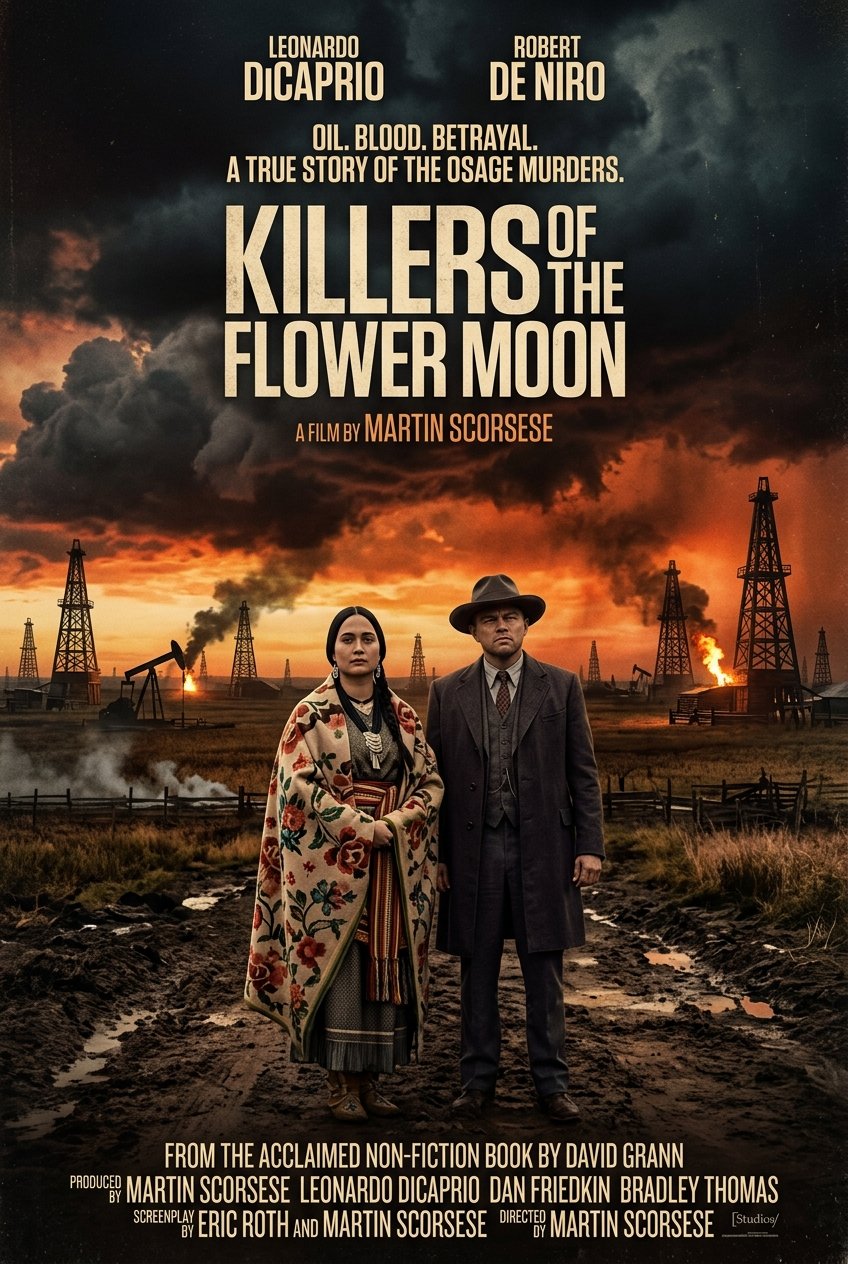
Introduction: Scorsese’s Most Important Film
Martin Scorsese is 80 years old, and Killers of the Flower Moon may be the most morally urgent film of his extraordinary career. This three-and-a-half-hour epic about the systematic murder of the Osage Nation people in 1920s Oklahoma — killed by white settlers seeking access to the oil beneath their reservation land — is simultaneously a specific historical reckoning, a devastating character study, and a meditation on the American capacity for self-delusion in the face of its own crimes. It is a masterwork by a filmmaker at the absolute height of his powers.
The Osage Murders: History That Demands Witness
In the early 1920s, members of the Osage Nation were the wealthiest people per capita in the world, following the discovery of enormous oil reserves beneath their land. White settlers responded to this reversal of the expected economic order by marrying into Osage families, then murdering their spouses to inherit their oil rights — a systematic campaign of murder that the local authorities, many of whom were complicit, ignored for years. The eventual FBI investigation — one of the Bureau’s first major cases — resulted in prosecutions that addressed only a fraction of the actual murders.
📖 Also Read
-
▶ The Zone of Interest (2023) Review – A Holocaust Film Unlike Any Other
-
▶ The Godfather (1972) Review – Francis Ford Coppola's Timeless Crime Epic
-
▶ Joker (2019) Review – Joaquin Phoenix's Terrifying Portrait of a Man on the Edge
-
▶ Poor Things (2023) Review – Emma Stone Shines in Lanthimos's Surreal Feminist Masterpiece
DiCaprio’s Ernest: The Face of Complicity
Leonardo DiCaprio plays Ernest Burkhart, a young WWI veteran who arrives in Osage County, falls genuinely in love with the Osage woman Mollie (Lily Gladstone), and then participates in the systematic murder of her family under the direction of his uncle William Hale (Robert De Niro). DiCaprio’s performance is his most psychologically complex: Ernest is not presented as simply evil, but as a man whose love for Mollie is real and whose moral blindness is the most disturbing kind — the kind that allows genuine affection to coexist with participation in atrocity.
Lily Gladstone: A Star Is Born
Lily Gladstone’s Mollie Burkhart is one of cinema’s great recent performances — a woman of intelligence, dignity, and perception who is being slowly poisoned by her husband’s family while the structures that should protect her are systematically captured by the people trying to kill her. Gladstone won the Golden Globe for Best Actress, becoming the first Native American woman to win that award. Her performance is remarkable for its restraint: Mollie’s awareness of what is happening to her, expressed through her eyes rather than speeches, is heartbreaking.
Robert De Niro: The Architecture of Corruption
De Niro plays William King Hale — the “King of the Osage Hills,” a man of considerable local power and charm who orchestrated the murders while presenting himself as the Osage Nation’s greatest friend and benefactor. De Niro plays him with the specific horror of a genuinely pleasant man whose pleasantness is completely genuine and whose monstrousness is equally genuine. Hale does not experience his crimes as crimes; he experiences them as clever business.
Scorsese’s Moral Clarity
Scorsese made a late-stage decision to change the film’s perspective — to tell the story from Ernest’s point of view rather than from the FBI investigators’, which was the approach of David Grann’s source book. This is a braver and more artistically interesting choice, placing the audience in the uncomfortable position of experiencing the crimes from the perspective of the perpetrators. It forces us to confront the psychology of complicity in a way that the investigative narrative would not.
Our Rating: ⭐ 9.1 / 10
Verdict: Devastating, essential, and made with complete artistic mastery. Killers of the Flower Moon is one of the most morally serious and cinematically accomplished American films in years. Required viewing.
Production Excellence and Technical Achievement
Killers of the Flower Moon stands as a remarkable achievement in contemporary filmmaking — a film that succeeds not just as entertainment but as a genuine work of cinematic craft. The production team brought together exceptional talent across every department: the cinematography captures each scene with visual intelligence, the production design creates environments that feel authentic and purposeful, and the editing maintains precisely the rhythm the story requires.
The sound design and musical score deserve particular recognition. These sonic elements work in concert with the visual storytelling to create an immersive experience that engages the audience on multiple sensory levels simultaneously. The score, in particular, elevates key sequences beyond what the visuals alone could achieve — creating emotional resonance that persists beyond the specific moments it accompanies.
Themes and Cultural Resonance
What makes Killers of the Flower Moon genuinely important rather than merely entertaining is its engagement with themes that extend beyond its immediate narrative. The film asks questions that resonate with contemporary experience: about identity and transformation, about the costs of ambition and the meaning of success, about the relationships between individuals and the communities and institutions that shape them. These themes are not imposed upon the story but emerge naturally from it, which is the mark of genuinely accomplished screenwriting.
The performances throughout are of exceptional quality. The central performance anchors the film with authenticity and emotional intelligence, making the character’s journey feel personally true rather than narratively convenient. The supporting cast creates a fully realized world around that central performance, ensuring that every scene has the texture of genuine human interaction rather than plot mechanics.
Legacy and Recommendation
Killers of the Flower Moon earns its place among the finest films of its year and its genre. It is the kind of film that reminds audiences why cinema matters — why this particular form of storytelling, with its unique combination of image, sound, performance, and time, can achieve things that no other medium can. It rewards attentive viewing and repays revisitation, revealing new dimensions of craft and meaning with each viewing.
Recommended For: Viewers who appreciate quality filmmaking and emotional authenticity. Best Experienced: With full attention, in the best viewing environment available. This is a film that rewards the investment of genuine engagement.
[…] ▶ Killers of the Flower Moon (2023) Review – Scorsese's Devastating American Epic […]
[…] ▶ Killers of the Flower Moon (2023) Review – Scorsese's Devastating American Epic […]
[…] ▶ Killers of the Flower Moon (2023) Review – Scorsese's Devastating American Epic […]