
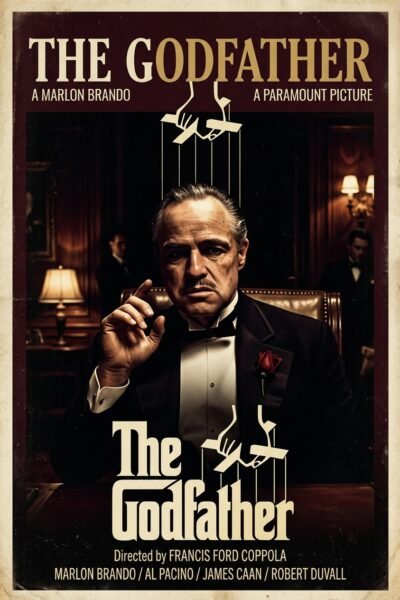
Introduction: The Greatest Film Ever Made
The Godfather is not merely the greatest gangster film ever made. It is not merely the greatest American film ever made. It is, by the consensus of critics, filmmakers, and audiences across fifty years of cinema history, simply the greatest film ever made — the standard against which everything else is measured, the reference point that requires no further context, the film that any serious lover of cinema must engage with. Francis Ford Coppola’s 1972 adaptation of Mario Puzo’s novel is a work of complete creative mastery: a film in which every element — performance, direction, cinematography, music, editing, production design — achieves the highest possible expression of its craft.
The Corleone Family: An American Myth
The Godfather tells the story of the Corleone crime family — specifically, the transition of power from aging patriarch Vito (Marlon Brando) to his youngest son Michael (Al Pacino). It is a family drama as much as a crime film: the relationships between siblings, the weight of patriarchal expectation, the negotiation between old-world values and American ambition, the cost of power on the people who hold it.
📖 Also Read
-
▶ Killers of the Flower Moon (2023) Review – Scorsese's Devastating American Epic
-
▶ The Zone of Interest (2023) Review – A Holocaust Film Unlike Any Other
-
▶ Joker (2019) Review – Joaquin Phoenix's Terrifying Portrait of a Man on the Edge
-
▶ The Odyssey (2026) – Christopher Nolan’s Epic Adaptation Starring Matt Damon & Tom Holland
Michael Corleone begins the film as a genuine innocent — a decorated war hero who has returned from service determined to live an honorable life outside the family business. He watches his brothers with a combination of love and mild contempt for their entanglement in the world of violence and corruption that he has chosen to reject. By the film’s final frame, he has become more powerful and more ruthless than his father ever was — and the tragedy of this transformation is the film’s deepest and most enduring theme.
Marlon Brando: An Iconic Creation
Brando’s Vito Corleone is one of cinema’s most celebrated characterizations — the gravelly, compromised voice, the cotton-stuffed cheeks, the courtly manner that masks absolute ruthlessness, the genuine love for his family that coexists with the casual violence of his world. Brando won the Academy Award for Best Actor and refused it in protest of Hollywood’s treatment of Native Americans — a decision that generated more controversy than the performance itself. The performance has become so culturally embedded that it transcends the film, but watching it in context, what strikes you is its humanity. Vito is not primarily frightening — he is primarily a man who loves his family and has made certain accommodations with the world to protect them.
Al Pacino’s Michael: The Tragedy of Transformation
If Brando’s Vito is the film’s iconic presence, Pacino’s Michael is its true subject and its deepest achievement. The transformation of Michael Corleone from reluctant outsider to ruthless patriarch is one of cinema’s great character arcs — slow, cumulative, internally logical, and devastating. Pacino plays each stage of Michael’s development with complete commitment: the initial detachment, the first decisive act of violence, the deliberate assumption of his father’s role, and finally the terrible closed-off coldness of the film’s final scene.
Gordon Willis’s Cinematography: The Grammar of Power
Gordon Willis — nicknamed “the Prince of Darkness” — created a visual language for The Godfather that has been endlessly imitated but never quite matched. His choice to shoot the interiors in near-darkness, with key light coming from practical sources above, creates faces that emerge from shadow with a gravity and weight that the subject demands. The darkness is not merely aesthetic; it is expressive. These are men who operate in shadows, whose true natures are partially concealed even from themselves.
Nino Rota’s Score: The Sound of Loss
Nino Rota’s score for The Godfather is one of cinema’s great musical achievements. The main theme — yearning, melancholic, inescapably beautiful — seems to contain the entire emotional range of the film in its opening bars. It is the sound of a world being lost even as it is preserved, of beauty inseparable from corruption, of love that comes at an unacceptable cost.
Our Rating: ⭐ 9.8 / 10
Verdict: Essential. Fundamental. The Godfather is cinema at its absolute highest achievement. Every person who loves film must see it, and see it more than once.
Production Excellence and Technical Achievement
The Godfather stands as a remarkable achievement in contemporary filmmaking — a film that succeeds not just as entertainment but as a genuine work of cinematic craft. The production team brought together exceptional talent across every department: the cinematography captures each scene with visual intelligence, the production design creates environments that feel authentic and purposeful, and the editing maintains precisely the rhythm the story requires.
The sound design and musical score deserve particular recognition. These sonic elements work in concert with the visual storytelling to create an immersive experience that engages the audience on multiple sensory levels simultaneously. The score, in particular, elevates key sequences beyond what the visuals alone could achieve — creating emotional resonance that persists beyond the specific moments it accompanies.
Themes and Cultural Resonance
What makes The Godfather genuinely important rather than merely entertaining is its engagement with themes that extend beyond its immediate narrative. The film asks questions that resonate with contemporary experience: about identity and transformation, about the costs of ambition and the meaning of success, about the relationships between individuals and the communities and institutions that shape them. These themes are not imposed upon the story but emerge naturally from it, which is the mark of genuinely accomplished screenwriting.
The performances throughout are of exceptional quality. The central performance anchors the film with authenticity and emotional intelligence, making the character’s journey feel personally true rather than narratively convenient. The supporting cast creates a fully realized world around that central performance, ensuring that every scene has the texture of genuine human interaction rather than plot mechanics.
Legacy and Recommendation
The Godfather earns its place among the finest films of its year and its genre. It is the kind of film that reminds audiences why cinema matters — why this particular form of storytelling, with its unique combination of image, sound, performance, and time, can achieve things that no other medium can. It rewards attentive viewing and repays revisitation, revealing new dimensions of craft and meaning with each viewing.
Recommended For: Viewers who appreciate quality filmmaking and emotional authenticity. Best Experienced: With full attention, in the best viewing environment available. This is a film that rewards the investment of genuine engagement.

[…] ▶ The Godfather (1972) Review – Francis Ford Coppola's Timeless Crime Epic […]