
Introduction: Frankenstein Reimagined as Liberation Narrative
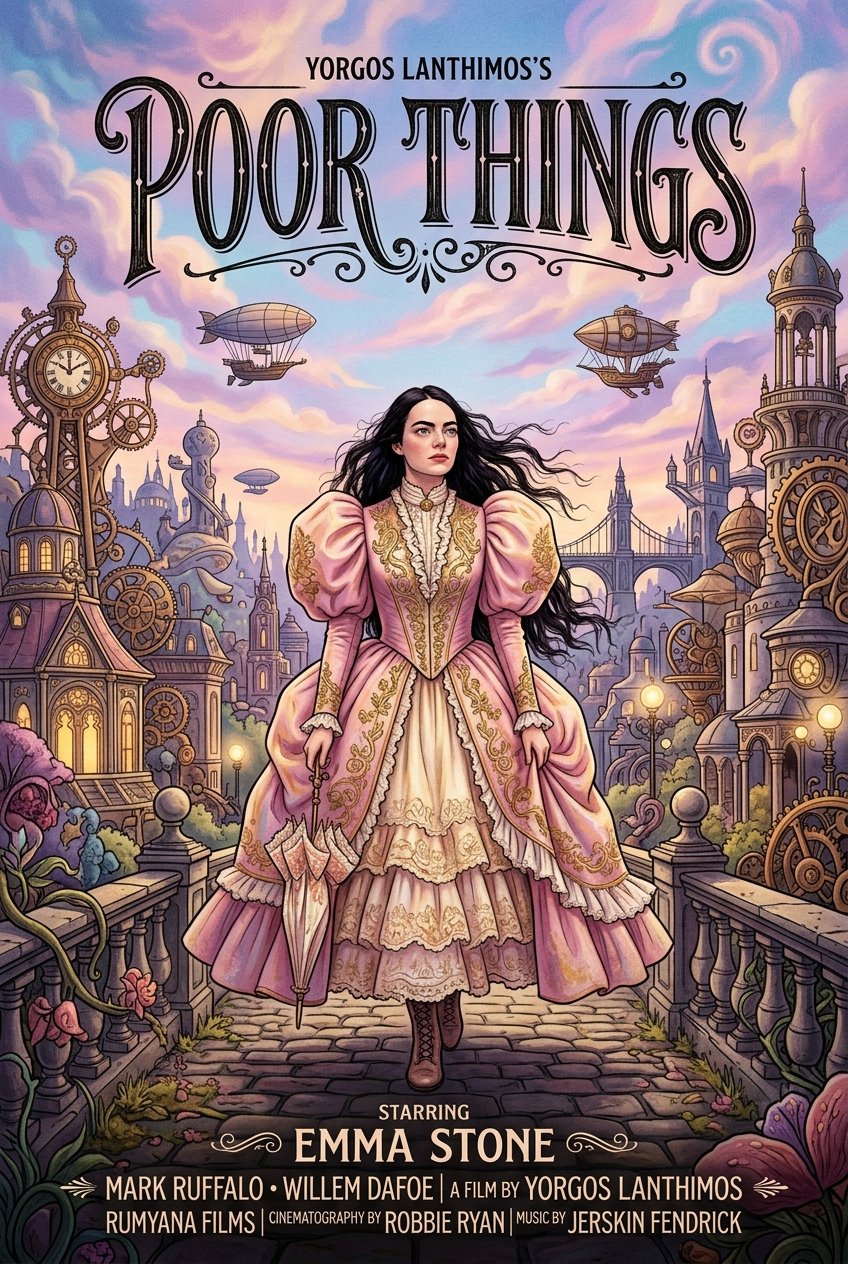
Poor Things won the Golden Lion at the Venice Film Festival and the Academy Award for Best Actress for Emma Stone — the most celebrated film of 2023, and one of the most singular works in recent cinema. Yorgos Lanthimos’s adaptation of Alasdair Gray’s 1992 novel is a surreal, darkly comic, sexually explicit, intellectually playful, and ultimately deeply moving adventure — the story of Bella Baxter, a woman brought back to life with the brain of her unborn child, who experiences the world with the radical openness of someone entirely unburdened by social conditioning.
Emma Stone’s Bella: One of Cinema’s Great Performances
Emma Stone’s performance as Bella Baxter requires her to play several stages of cognitive and emotional development across the film’s running time — from the infant cognition of the early scenes, through the adolescent curiosity and rebellion of the middle section, to the fully formed adult of the film’s conclusion. She adjusts her physicality, her speech patterns, her emotional register, and her way of moving through the world at each stage with extraordinary precision. It is technically astonishing work, and more importantly, it is genuinely funny, genuinely moving, and genuinely compelling as character.
📖 Also Read
-
▶ Oppenheimer (2023) Masterpiece Review – Christopher Nolan’s Atomic Drama
-
▶ The Zone of Interest (2023) Review – A Holocaust Film Unlike Any Other
-
▶ Killers of the Flower Moon (2023) Review – Scorsese's Devastating American Epic
-
▶ Tár (2022) Review – Cate Blanchett's Towering Performance in Cinema's Most Complex Film
Bella’s defining characteristic is her total absence of shame and her radical commitment to following curiosity wherever it leads. She investigates the world with the unfiltered directness of someone who has not yet learned what she’s supposed to want, what she’s supposed to feel, what she’s supposed to pretend. Her journey through sex, philosophy, poverty, politics, and self-determination is the film’s narrative and its argument: that the social conditioning that shapes “normal” women’s lives is not natural but manufactured, and that liberation begins with the refusal to pretend.
Lanthimos’s Visually Extraordinary World
Robbie Ryan’s cinematography — moving between black-and-white and oversaturated color, frequently employing fish-eye lenses that distort perspective to suggest Bella’s subjective experience — creates a world that feels genuinely unlike anything else in cinema. The production design is spectacular: a vision of a vaguely Victorian alternate world in which the usual physical and social rules are loosened, where Bella’s creator Godwin Baxter (Willem Dafoe, in extraordinary form) breeds animals together and constructs human beings, and where the visual language of Victorian propriety exists alongside the frank acknowledgment of physical reality that Victorian culture suppressed.
Mark Ruffalo’s Duncan: Toxicity With a Smile
Mark Ruffalo plays Duncan Wedderburn, the rakish lawyer who accompanies Bella on her European adventures, with magnificent, escalating comic desperation. He is introduced as a charming libertine and gradually revealed as a man whose liberalism extends only as far as his own convenience — who is charmed by Bella’s freedom when he controls it and frightened by it when she claims it for herself. Ruffalo throws himself into the role’s physical comedy with complete commitment, and the result is one of the funniest performances of the year.
Our Rating: ⭐ 8.8 / 10
Verdict: Strange, funny, moving, and absolutely original. Poor Things is a film that earns its provocations because it has genuine intelligence and genuine heart beneath its surrealist surface. Essential cinema of the highest order.
Production Excellence and Technical Achievement
Poor Things stands as a remarkable achievement in contemporary filmmaking — a film that succeeds not just as entertainment but as a genuine work of cinematic craft. The production team brought together exceptional talent across every department: the cinematography captures each scene with visual intelligence, the production design creates environments that feel authentic and purposeful, and the editing maintains precisely the rhythm the story requires.
The sound design and musical score deserve particular recognition. These sonic elements work in concert with the visual storytelling to create an immersive experience that engages the audience on multiple sensory levels simultaneously. The score, in particular, elevates key sequences beyond what the visuals alone could achieve — creating emotional resonance that persists beyond the specific moments it accompanies.
Themes and Cultural Resonance
What makes Poor Things genuinely important rather than merely entertaining is its engagement with themes that extend beyond its immediate narrative. The film asks questions that resonate with contemporary experience: about identity and transformation, about the costs of ambition and the meaning of success, about the relationships between individuals and the communities and institutions that shape them. These themes are not imposed upon the story but emerge naturally from it, which is the mark of genuinely accomplished screenwriting.
The performances throughout are of exceptional quality. The central performance anchors the film with authenticity and emotional intelligence, making the character’s journey feel personally true rather than narratively convenient. The supporting cast creates a fully realized world around that central performance, ensuring that every scene has the texture of genuine human interaction rather than plot mechanics.
Legacy and Recommendation
Poor Things earns its place among the finest films of its year and its genre. It is the kind of film that reminds audiences why cinema matters — why this particular form of storytelling, with its unique combination of image, sound, performance, and time, can achieve things that no other medium can. It rewards attentive viewing and repays revisitation, revealing new dimensions of craft and meaning with each viewing.
Recommended For: Viewers who appreciate quality filmmaking and emotional authenticity. Best Experienced: With full attention, in the best viewing environment available. This is a film that rewards the investment of genuine engagement.



[…] ▶ Poor Things (2023) Review – Emma Stone Shines in Lanthimos's Surreal Feminist Masterpiec… […]
[…] ▶ Poor Things (2023) Review – Emma Stone Shines in Lanthimos's Surreal Feminist Masterpiec… […]