
Introduction & The Weight of History
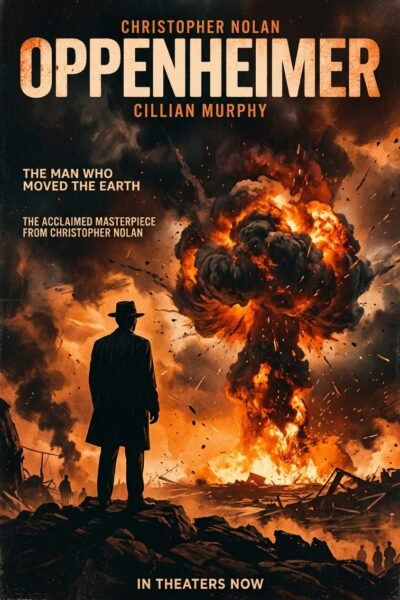
Christopher Nolan’s Oppenheimer is an epic biographical thriller that examines one of the most pivotal and terrifying turning points in human history: the invention of the atomic bomb. Adapted from Kai Bird and Martin J. Sherwin’s Pulitzer Prize-winning biography American Prometheus, Nolan crafts an intense 3-hour psychological study of J. Robert Oppenheimer, the theoretical physicist who led the Manhattan Project at Los Alamos. Rather than producing a traditional biographical film, Nolan delivers a tense, non-linear cinematic experience that explores the ethical paradoxes, personal rivalries, and devastating consequences of nuclear weapons.
Narrative Structure & Dual Perspectives
The film operates across two main timelines, distinguished visually by color and black-and-white film stock. The colored sequences, titled “Fission,” depict Oppenheimer’s subjective experience—his university days in Europe, his leadership at Los Alamos, and his secret 1954 security clearance hearing. The black-and-white sequences, titled “Fusion,” provide an objective perspective centered around Lewis Strauss (Robert Downey Jr.) during his 1959 Senate confirmation hearing for Secretary of Commerce.
📖 Also Read
-
▶ Poor Things (2023) Review – Emma Stone Shines in Lanthimos's Surreal Feminist Masterpiece
-
▶ The Zone of Interest (2023) Review – A Holocaust Film Unlike Any Other
-
▶ Killers of the Flower Moon (2023) Review – Scorsese's Devastating American Epic
-
▶ Parasite (2019) Review – Bong Joon-ho's Oscar-Winning Masterpiece of Class and Deception
This dual-timeline structure creates a gripping web of political suspense and personal betrayal. Nolan weaves quantum mechanics, leftist political rallies, military logistics, and Washington backroom politics into a fast-paced thriller that never loses momentum despite being heavily dialogue-driven.
Cillian Murphy’s Career-Defining Performance
Cillian Murphy delivers an extraordinarily subtle and haunting performance as J. Robert Oppenheimer. Murphy captures the enigmatic intellect, quiet charisma, and immense guilt of a man who opened Pandora’s box. His striking blue eyes carry the weight of the universe, communicating existential dread without speaking a single word. Murphy’s transformation over the course of four decades is seamless and deserving of every accolades bestowed upon it.
Robert Downey Jr. delivers a tour-de-force performance as Lewis Strauss, revealing the petty jealousy, political ambition, and calculating revenge beneath his polished exterior. Downey’s performance reminds audiences of his incredible dramatic range. Emily Blunt shines as Katherine “Kitty” Oppenheimer, particularly during a fierce cross-examination scene where she dismantles prosecutor Roger Robb (Jason Clarke). Matt Damon provides grounded energy as General Leslie Groves, the pragmatic military leader overseeing Los Alamos.
The Trinity Test & Technical Achievement
The centerpiece of the film is the Trinity Test sequence—the world’s first detonation of a nuclear weapon in the New Mexico desert. Nolan famously eschewed computer-generated imagery (CGI) for the explosion, recreating the chemical and visual effect practically. The result is a terrifying, hypnotic sequence where visual blinding light is followed by absolute silence, culminating in a deafening shockwave that shakes the theater. The sound design throughout the film, particularly the recurring rhythm of stomping feet in an amphitheater, acts as a terrifying metaphor for Oppenheimer’s internal anxiety and the impending nuclear arms race.
Ludwig Göransson’s Propulsive Score
Composer Ludwig Göransson delivers a breathtaking musical score that serves as the heartbeat of the film. Utilizing violins that range from delicate melodies to screeching, anxious dissonance, Göransson mirrors the frenzy of atomic subatomic particles. The absence of drums in the score creates an eerie, floating tension that accelerates during scientific breakthroughs and quiet interrogations alike.
Philosophical & Ethical Implications
Oppenheimer does not shy away from the horrific moral consequences of the atomic bombings of Hiroshima and Nagasaki. While the film refrains from depicting the bombings directly on screen, it channels the devastation through Oppenheimer’s horrifying hallucinations during a victory speech. The realization that humanity now possesses the power to destroy itself hangs over every scene, concluding with a haunting final interaction between Oppenheimer and Albert Einstein (Tom Conti).
Final Verdict
Christopher Nolan’s Oppenheimer is a monumental achievement in biographical filmmaking. It is a dense, intellectually stimulating, and emotionally shattering portrait of ambition, genius, and regret. Driven by Cillian Murphy’s towering performance and flawless technical craftsmanship, Oppenheimer stands as one of the most important films of the 21st century.
The Trinity Test: Cinema’s Most Terrifying Beautiful Moment
The detonation of the first atomic bomb at Trinity, New Mexico, on July 16, 1945, is Oppenheimer’s cinematic centerpiece, and Nolan frames it with an awareness of its dual nature — simultaneously one of the most astonishing scientific achievements in human history and the beginning of a new kind of horror. He shoots the sequence practically, without CGI, capturing the enormous fireball and shockwave with a physical reality that makes the audience feel the weight of the moment. Most memorably, he holds the sound — the explosion happens in silence, and the shockwave arrives only after several agonizing seconds. The audience understands what Oppenheimer understood: that what has just been witnessed cannot be unwatched.
The Security Hearing: Kafka in America
The 1954 security hearing — in which Oppenheimer’s security clearance was revoked, his loyalty questioned, and his career effectively ended — is depicted with the procedural horror of a Kafka novel. Nolan cuts between Oppenheimer’s hearing and the Senate confirmation hearing of Lewis Strauss, the AEC chairman who orchestrated Oppenheimer’s destruction, gradually revealing how a man of genuine patriotism and moral seriousness was sacrificed to Cold War political maneuvering and a small man’s wounded pride. The hearing sequences are among the film’s finest — Cillian Murphy conveying the humiliation and helplessness of a great mind being systematically reduced by institutional processes with devastating restraint.
Science, Politics, and the Faustian Bargain
Oppenheimer explores the Faustian dimension of scientific achievement with unusual courage. The scientists at Los Alamos were not naive about what they were building — they knew they were creating a weapon of mass destruction. They justified it in the specific context of World War Two and the Nazi nuclear program, and most of them believed they were preventing something worse. Whether this justification holds up is one of history’s most significant moral questions, and Nolan presents it without easy resolution. Oppenheimer’s famous post-Trinity quotation from the Bhagavad Gita — “Now I am become Death, the destroyer of worlds” — is both accurate and profoundly insufficient, which is precisely what makes it so resonant.
What Oppenheimer Means for Cinema
Oppenheimer’s commercial success — earning nearly $1 billion worldwide while being a three-hour dialogue-heavy historical drama — demonstrates something important about the relationship between audience intelligence and cinematic ambition. Nolan trusted his audience to engage with complex material, and the audience responded by making it one of the highest-grossing R-rated films in history. The film is proof that serious adult cinema and commercial viability are not mutually exclusive — that the audience exists for genuinely ambitious filmmaking, and that the industry’s tendency toward formula reflects its own risk-aversion rather than audience preference.


Leave a Reply