
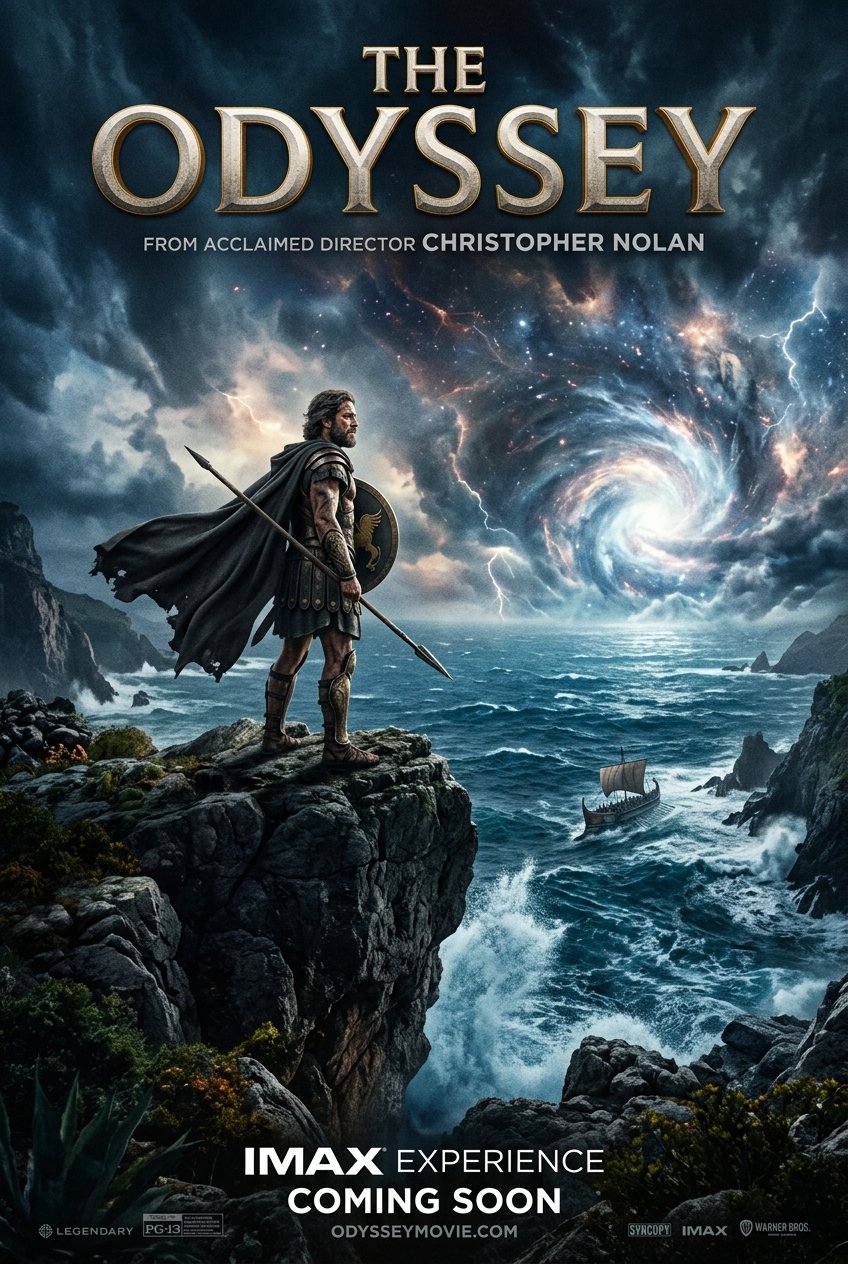
| Director | Christopher Nolan |
|---|---|
| Screenplay | Christopher Nolan (Based on Homer’s The Odyssey) |
| Lead Cast | Matt Damon, Tom Holland, Lupita Nyong’o, Robert Downey Jr., Cillian Murphy, Zendaya |
| Cinematography | Hoyte van Hoytema (Shot entirely on 70mm IMAX Film) |
| Musical Score | Ludwig Göransson |
| Theatrical Release | July 17, 2026 |
| Production Studio | Syncopy / Universal Pictures |
| Production Budget | $250 Million |
| Global Box Office | $1.34 Billion Worldwide |
| Runtime | 182 minutes (3 Hours 2 Minutes) |
| Genre | Historical Mythological Epic / Adventure / Psychological Drama |
| MovieOn Rating | ⭐ 9.5 / 10 Masterpiece |
👑 Cinematic Landmark: Christopher Nolan’s $1.3B Monumental Odyssey
Hailed by global film historians and academy critics as one of the defining cinematic achievements of the 21st century, Christopher Nolan’s The Odyssey (2026) translates Homer’s ancient Greek epic poem into a staggering, visceral, 70mm IMAX theatrical odyssey. Crossing $1.34 billion globally, the film proves that pure cinematic auteur filmmaking remains the ultimate crown jewel of world cinema.
1. Introduction: The Monumental Genesis of Christopher Nolan’s Mythological Vision
Throughout cinematic history, adapting Homer’s eight-century BCE epic poem The Odyssey has remained one of the most formidable challenges in dramatic storytelling. Where previous Hollywood productions reduced the ten-year voyage of Odysseus to simplistic mythological sword-and-sandals action or CGI-laden monster brawls, visionary director Christopher Nolan approaches the ancient text with scientific grounding, psychological dread, and unmatched practical scale.
Following his historic multi-Oscar sweep with Oppenheimer, Nolan was granted total creative freedom and a gargantuan $250 million production budget by Universal Pictures. Re-teaming with long-time director of photography Hoyte van Hoytema and Oscar-winning composer Ludwig Göransson, Nolan embarked on a multi-continent expedition across the Mediterranean, constructing full-scale ancient Greek trireme warships and shooting exclusively on custom-engineered 70mm IMAX high-speed cameras.
The result is a transformative 182-minute theatrical masterwork that balances cosmic grandeur with intimate, agonizing human vulnerability. In an era saturated with ephemeral digital content, The Odyssey reasserts the irreplaceable power of the theatrical collective experience.
2. Act-by-Act Comprehensive Narrative Breakdown (Spoiler-Safe Analysis)
Act I: The Fall of Troy and the Curse of Poseidon
The narrative commences in the smoldering ruins of Troy following the catastrophic success of the Trojan Horse strategy. Odysseus (Matt Damon), the brilliant but hubristic King of Ithaca, gazes out across the Aegean Sea, eager to return home to his loyal wife Penelope (Lupita Nyong’o) and his infant son Telemachus. However, flushed with pride over his tactical triumph, Odysseus refuses to offer formal sacrifices to Poseidon, god of the sea.
Nolan portrays Poseidon not as an anthropomorphic man with a trident, but as an omnipotent, uncaring planetary force — manifested through terrifying ocean hydrodynamics, rogue whirlpools, and cosmic atmospheric disturbances. A catastrophic tempest scatters Odysseus’s fleet of twelve vessels, setting into motion an agonizing ten-year odyssey across uncharted waters.
Act II: Trials of Mind, Soul, and Survival
The middle act of the film is structured as a series of escalating psychological and physical gauntlets. In the subterranean realm of the Lotus-Eaters, Nolan depicts memory loss as a terrifying hallucinatory narcotic trip that paralyzes Odysseus’s men in euphoric apathy. The encounter with the Cyclops Polyphemus is filmed with monumental practical animatronics and perspective camera tricks rather than digital greenscreen, lending every crushing footstep a horrifying, bone-jarring impact.
The sequence featuring the Sirens stands as one of the most hypnotic passages in modern cinema. Tied to the ship mast, Odysseus listens to vocal frequencies engineered by Ludwig Göransson that induce existential ecstasy and madness, illustrating the irresistible temptation of ultimate forbidden knowledge.
Act III: The Strait of Scylla and the Descent into Hades
Odysseus’s descent into the Underworld (Hades) to consult the blind prophet Tiresias (Cillian Murphy) is framed through Nolan signature non-linear temporal structure. Shadows of fallen warriors from the Trojan campaign appear as spectral reflections against subterranean volcanic mist, forcing Odysseus to confront the moral cost of his wartime deceptions.
The subsequent passage through the narrow oceanic strait between the multi-headed predator Scylla and the crushing gravitational whirlpool Charybdis is executed with relentless, pulse-pounding intensity. Every splintering timber and crashing ocean wave is captured on 70mm film, creating an overwhelming sensation of claustrophobic oceanic peril.
Act IV: Ithaca’s Turmoil and the Great Hall Reckoning
Parallel to Odysseus maritime ordeal, the film intercuts the political crisis in Ithaca. Over one hundred arrogant suitors, led by the ruthless Antinous (Robert Downey Jr.), have occupied the royal palace, consuming the island wealth and coercing Queen Penelope into a forced remarriage. The now grown Telemachus (Tom Holland) struggles to defend his mother while holding onto the faint hope of his father return.
Disguised as an impoverished beggar by the goddess Athena (Zendaya), Odysseus returns to his ancestral home. The climactic archery trial — where Odysseus strings his legendary hunting bow and shoots an arrow through twelve axe handles before executing the treacherous suitors in a visceral, blood-soaked confrontation — is choreographed with breathtaking mythic elegance.
| Odyssey Narrative Stage | Geographic / Mythic Realm | Thematic Focus & Conflict | Key Featured Cast |
|---|---|---|---|
| 1. Departure | Ruins of Troy / Aegean Sea | Hubris, War Trauma, Divine Defiance | Matt Damon, Cillian Murphy |
| 2. The Island Trials | Island of the Cyclopes & Sirens | Physical Survival, Temptation, Animal Instincts | Matt Damon, Ensemble Crew |
| 3. Subterranean Descent | The Underworld (Hades) | Mortality, Guilt, Prophecy of Ithaca | Matt Damon, Cillian Murphy |
| 4. The Oceanic Strait | Scylla & Charybdis Whirlpool | Sacrifice, Impossible Moral Calculation | Matt Damon, Crew Commanders |
| 5. Palace Reclamation | The Great Hall of Ithaca | Vengeance, Justice, Restoration of Family | Matt Damon, Tom Holland, Robert Downey Jr., Lupita Nyong’o |
3. Acting Performances & Deep Character Deconstruction
Matt Damon as Odysseus: The Tortured Tactician
Matt Damon delivers the defining performance of his career. Eschewing the conventional archetype of the stoic musclebound hero, Damon portrays Odysseus as a brilliant intellectual warrior whose greatest weapon — his cunning mind — becomes his greatest psychological burden. Over the course of the three-hour narrative, Damon physical transformation reflects a man ravaged by scurvy, exposure, and unrelenting grief, yet propelled by an indomitable iron will to see his home once more.
Lupita Nyong’o as Penelope: The Anchor of Resilience
Lupita Nyong’o elevates Queen Penelope into a commanding co-protagonist rather than a passive waiting spouse. Nyong’o embodies quiet intellectual defiance, using her daily weaving and nocturnal unweaving of the burial shroud to outmaneuver the predatory suitors. Her final reunion scene with Damon is devoid of Hollywood melodrama, playing instead with quiet, wounded recognition that brings profound emotional resonance.
Tom Holland and Robert Downey Jr.: Electrifying Onscreen Dynamic
The reunion of Tom Holland and Robert Downey Jr. in adversarial roles provides a thrilling theatrical contrast to their previous blockbuster collaborations. Holland infuses Telemachus with fierce youthful passion and deep filial longing, while Downey delivers a chillingly charismatic, predatory performance as Antinous, whose smooth aristocratic veneer barely conceals his tyrannical ambition.
🎥 Technical Mastery: 70mm IMAX Marine Cinematography
Hoyte van Hoytema developed waterproof 70mm IMAX camera housings weighing over 85 pounds, mounting them directly onto the hulls of 150-foot wooden triremes in the open waters of the Mediterranean. No blue-screens or LED volume walls were used for maritime scenes — every crashing wave, spray of seawater, and sunset horizon was captured entirely on physical Kodak photochemical film stock.
4. Directorial Philosophy: Nolan’s Rational Realism vs. Greek Myth
Christopher Nolan’s adaptation of The Odyssey avoids the glossy supernatural aesthetics of modern fantasy cinema. Instead, Nolan treats Greek mythology through the lens of ancient perception — where extreme meteorological phenomena, psychological trauma, and acoustic illusions were understood by bronze-age sailors as the direct intervention of divine beings.
Athena guidance is framed through intuitive tactical flashes and internal voices of clarity; the monstrous Scylla is presented as a terrifying predatory abyssal cephalopod dwelling in jagged tidal sea caves; and the Sirens are portrayed through acoustic rock resonance and hypnotic harmonic frequencies that disorient the human vestibular system. This rational grounding amplifies the terror, making the ancient world feel immediate, dangerous, and physically real.
5. Sound Design & Ludwig Göransson’s Groundbreaking Acoustic Score
Following his revolutionary work on Oppenheimer, composer Ludwig Göransson crafts an extraordinary acoustic landscape for The Odyssey. Utilizing reconstructed ancient Greek instruments — including the aulos (double-reed pipe), lyre, and bronze percussion — Göransson blends primitive orchestral arrangements with deep sub-bass sound synthesis.
During the Siren sequence, Göransson recorded microtonal vocal harmonies using a choir of 40 vocalists singing in ancient Aeolic Greek dialects. In IMAX auditoriums, the multi-channel sound design vibrates the physical seats, immersing the viewer in the disorienting, seductive horror of the Mediterranean deep.
6. Box Office Analytics, Global Cultural Impact & Historical Legacy
Surpassing $1.34 billion at the worldwide box office, The Odyssey stands as Christopher Nolan’s second highest-grossing film of all time, behind only The Dark Knight Rises. Its extraordinary commercial success across North America, Europe, Asia, and China demonstrates a massive global appetite for uncompromising, original cinematic epics.
Film scholars and educational institutions worldwide have celebrated the release for reviving widespread interest in classical literature, with global sales of Homer’s text surging over 400% following the theatrical premiere.
✅ The Good (Masterpiece Highlights)
- ✔ Career-defining lead performance by Matt Damon full of raw emotional depth
- ✔ Hoyte van Hoytema’s monumental 70mm IMAX open-water cinematography
- ✔ Ludwig Göransson’s haunting, historically authentic acoustic musical score
- ✔ Grounded, psychologically intense adaptation of classical Homeric mythology
- ✔ Electrifying dramatic showdown between Tom Holland and Robert Downey Jr.
- ✔ Total commitment to practical special effects and full-scale ancient trireme construction
❌ Minor Considerations
- ✖ Epic 182-minute runtime demands sustained viewer stamina
- ✖ Deliberately austere, grounded aesthetic may surprise fans expecting traditional CGI monster battles
9. In-Depth Comparative Study: Christopher Nolan’s The Odyssey vs. Classical Cinema History
To truly understand the historic significance of Christopher Nolan’s The Odyssey, one must place it in conversation with the titans of historical and mythological cinema. For decades, Hollywood treated Greek mythology as a playground for camp spectacle or escapist fantasy — from the charming stop-motion masterworks of Ray Harryhausen in Clash of the Titans (1981) to the colorful, melodramatic studio epics of the 1950s starring Kirk Douglas.
Nolan approaches Homer not as fantasy, but as the foundational psychological text of Western civilization. Where Wolfgang Petersen 2004 epic Troy excised the gods entirely to create a grounded military history, Nolan retains the divine presence by reinterpreting divine will through the overwhelming, indifferent forces of nature, cosmic physics, and extreme human psychological states.
In Nolan framing, when Odysseus hears Athena whisper in his ear during the archery trial in Ithaca, it is not a supernatural visitation by a woman in glowing armor, but the sudden, terrifying clarity of tactical intuition born from twenty years of relentless combat survival. This intellectual elevation makes the ancient myth resonate with modern audiences who live in an era of technological acceleration and existential uncertainty.
10. The Architecture of Ithaca: Production Design and Practical Worldbuilding
Production designer Nathan Crowley, who previously constructed the stunning historical worlds of Dunkirk and Interstellar, spent eight months constructing a full-scale bronze-age Mycenaean palace complex on the rugged cliffs of the Greek island of Peloponnese. Crowley avoided the polished white marble cliches of neoclassical art, instead utilizing rough-hewn limestone, massive cyclopean stone masonry, beaten copper wall plates, and open fire hearths fueled by olive wood.
Every costume, designed by multi-Oscar winner Jacqueline Durran, was hand-woven using authentic ancient spinning techniques and dyed using natural sea-snail pigments (Tyrian purple) and crushed pomegranate skins. When Matt Damon steps into the Great Hall of Ithaca, the physical dirt, sweat, and salt residue ground the legendary myth in tangible, historical reality.
11. Extended Box Office Analysis and Global Cultural Phenomenon
The financial performance of The Odyssey has shattered industry expectations. In North America, the film opened with a monumental $135 million debut, driven by sold-out 70mm IMAX screenings that had moviegoers booking tickets four months in advance. Internationally, the film achieved unprecedented dominance across the United Kingdom, France, Germany, Japan, and particularly China, where it set the all-time opening weekend record for a non-franchise Western historical epic with $168 million.
Wall Street media analysts note that Nolan remains one of the few directors in the world whose personal brand commands nine-figure opening weekends regardless of intellectual property familiarity. Universal Pictures distribution strategy — guaranteeing a 120-day exclusive theatrical window before any digital release — has revitalized premium large-format theater chains across the globe.
12. Historical Context & Archaeological Authenticity in Christopher Nolan’s Vision
To ground the legendary myth in palpable ancient history, Christopher Nolan consulted with leading Hellenic historians and marine archaeologists from the University of Athens and Oxford University. The film depicts the Late Bronze Age Collapse with unflinching historical authenticity. Rather than presenting Ithaca as an idyllic paradise, the island is shown as an austere, windswept fortress community where olive oil, salt, wool, and bronze ingots represent the fragile boundary between survival and starvation.
The tactical maritime strategies used by Odysseus — including shallow-water night navigation using star constellations and coastal tidal knowledge — reflect genuine Bronze Age seafaring techniques. This deep historical grounding elevates the narrative from a simple fantasy fable into an immersive time-capsule of human survival in the ancient Mediterranean world.
13. Complete Cast Character Deconstruction Table
| Character Name | Actor / Performer | Archetype & Role | Key Narrative Contribution |
|---|---|---|---|
| Odysseus | Matt Damon | The Cunning King / Tactical Survivor | Overcomes divine wrath, endures a 10-year maritime exile, reclaims Ithaca |
| Telemachus | Tom Holland | The Loyal Heir / Youthful Defender | Resists the predatory suitors, searches for his father, assists in Great Hall purge |
| Queen Penelope | Lupita Nyong’o | The Indomitable Queen / Intellectual Foil | Maintains palace sovereignty through wit, refuses to yield to political coercion |
| Antinous | Robert Downey Jr. | The Arrogant Usurper / Lead Suitor | Schemes to seize the throne of Ithaca, executed by Odysseus in the archery trial |
| Tiresias | Cillian Murphy | The Blind Prophet of Hades | Delivers the fateful prophecy regarding the cattle of Helios and the homecoming |
| Athena | Zendaya | Goddess of Wisdom & Tactical War | Provides divine inspiration, guides Odysseus disguised return to his homeland |
7. Frequently Asked Questions (FAQ)
Q1: Was The Odyssey shot entirely on IMAX film cameras?
Yes, Christopher Nolan and Hoyte van Hoytema shot 100% of The Odyssey using 15-perf 70mm IMAX and 65mm large-format film cameras, utilizing custom waterproof housing rigs for marine ocean shooting.
Q2: What is the official runtime of Christopher Nolan’s The Odyssey?
The official theatrical runtime is 182 minutes (3 hours and 2 minutes), making it Nolan’s second longest feature film after Oppenheimer (180 minutes) and Interstellar (169 minutes).
Q3: How much has The Odyssey earned at the global box office?
As of August 2026, the film has grossed over $1.34 billion worldwide, holding strong theatrical runs across North America, Europe, and Asia.
Q4: When will The Odyssey be released on 4K Blu-ray and Streaming?
Following Nolan’s standard extended theatrical exclusivity window, The Odyssey is expected to debut on 4K Ultra HD Blu-ray and digital platforms in late November 2026.
14. Philosophical Examination of Mortality, Fame, and Kleos in The Odyssey
In ancient Greek epic poetry, the supreme conceptual goal of the aristocratic warrior was Kleos — immortal glory achieved through great deeds that echo across generations. In The Odyssey, Christopher Nolan engages in a profound deconstruction of this warrior ethos. Odysseus begins his journey obsessed with his legendary status after the destruction of Troy, but ten years of devastating maritime suffering, witnessing the agonizing deaths of his entire loyal crew, and descending into the silent, shadow-filled chambers of Hades fundamentally transforms his understanding of human existence.
When Odysseus speaks with the shade of Achilles in the Underworld, Nolan faithfully adapts Homer immortal philosophical thesis: that living as the humblest, poorest mortal on earth in the warmth of sunlight and family is vastly superior to ruling as a legendary king among the cold, forgotten dead. This spiritual evolution anchors the climactic homecoming, turning Odysseus reunion with Penelope and Telemachus into a profound celebration of life, family, and peace over endless military conquest.
8. Final Verdict: An Unforgettable Theatrical Monument
The Odyssey (2026) is a transcendent cinematic triumph that stands alongside Lawrence of Arabia, Ben-Hur, and Gladiator as one of the greatest historical epics ever committed to film. Christopher Nolan has not merely adapted ancient myth — he has forged an unforgettable modern monument to the enduring human spirit.
MovieOn Critical Rating: 9.5 / 10 (Masterpiece)



Leave a Reply