
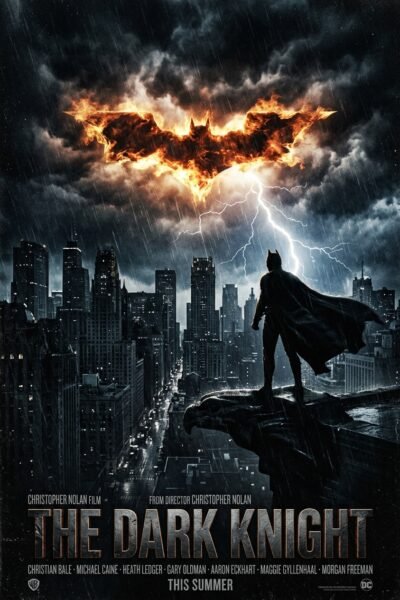
Introduction & Superhero Cinema Revolution
When Christopher Nolan’s The Dark Knight premiered in the summer of 2008, it fundamentally altered the landscape of blockbuster cinema. Prior to its release, comic book adaptations were often viewed as lightweight entertainment tailored primarily for younger audiences. Following the grounded origin story established in Batman Begins (2005), Nolan crafted a sprawling crime saga heavily influenced by Michael Mann’s Heat and classic noir thrillers. The Dark Knight transcended its superhero genre roots to become a profound exploration of order, chaos, escalation, and urban morality.
The Battle for Gotham’s Soul
The film centers on a triangular conflict for Gotham City’s future. Batman / Bruce Wayne (Christian Bale), District Attorney Harvey Dent (Aaron Eckhart), and Lieutenant Jim Gordon (Gary Oldman) form an uneasy alliance to dismantle organized crime once and for all. Their success forces the desperate mob families to enlist the services of the Joker (Heath Ledger), a theatrical criminal mastermind with no origin, no name, and no conventional motivation. Unlike typical villains seeking wealth or domination, the Joker seeks to prove that beneath civilization’s surface, humanity is inherently corrupt and chaotic.
📖 Also Read
Heath Ledger’s Transcendent Joker
Heath Ledger’s performance as the Joker remains one of the most iconic achievements in film history. Ledger inhabited the character completely, developing a distinctive raspy voice, compulsive lip-smacking habit, and unpredictable physical movement. Ledger’s Joker is an agent of pure anarchy—an unstoppable force meeting an immovable object in Batman.
Christian Bale provides a solid, brooding counterweight as Bruce Wayne, capturing the physical toll and isolation of vigilante life. Aaron Eckhart gives a tragic, powerful performance as Harvey Dent, capturing his fall from Gotham’s “White Knight” to the vengeful Two-Face. Gary Oldman anchors the emotional sanity of the film as Jim Gordon, a good man struggling to do right in a corrupt system.
IMAX Cinematography & Practical Action
Cinematographer Wally Pfister made history by utilizing 70mm IMAX cameras for major action sequences, bringing unprecedented scale and clarity to Gotham’s street battles. Nolan’s commitment to practical stunts—such as flipping an actual 18-wheeler truck upside down in the middle of Chicago’s financial district—gives the action sequences an undeniable weight and realism that CGI cannot replicate.
Hans Zimmer & James Newton Howard’s Score
The musical score, co-composed by Hans Zimmer and James Newton Howard, is brilliant in its psychological subtlety. The Joker’s motif—a single, rising razor-sharp cello note that increases in volume and distortion—creates instant anxiety whenever the character appears on screen. In contrast, Harvey Dent’s noble brass theme degrades over the course of the film, reflecting his moral downfall.
Themes of Escalation & Morality
The Dark Knight delves deep into post-9/11 themes of surveillance, extrajudicial justice, and societal collapse. It asks hard questions: How far can a society go to protect itself before becoming the very monster it fights? By accepting the role of the villain to preserve Harvey Dent’s legacy, Batman makes the ultimate sacrifice, embodying the film’s famous thesis: “You either die a hero, or you live long enough to see yourself become the villain.”
Final Verdict
The Dark Knight is not just a great superhero movie; it is a cinematic masterpiece. Flawlessly directed, impeccably acted, and intellectually rich, Christopher Nolan’s masterpiece remains the definitive gold standard of modern action cinema.
Aaron Eckhart’s Harvey Dent: The Tragedy of the White Knight
Heath Ledger’s Joker dominates discussion of The Dark Knight, but Aaron Eckhart’s performance as Harvey Dent deserves recognition as equally essential to the film’s structure and themes. Dent is Gotham’s “white knight” — the legitimate face of justice, the hope that the city might heal itself through proper institutions rather than through the extralegal actions of a masked vigilante. His transformation into Two-Face is the film’s darkest revelation: that even the most committed idealist has a threshold beyond which grief and pain can overwhelm principle. The Joker’s real victory is not over Batman but over Harvey Dent — he turns Gotham’s best hope into a force for random destruction, proving his thesis that any moral system can be broken by sufficient suffering.
Wally Pfister’s IMAX Cinematography
The Dark Knight was among the first films to use IMAX cameras for significant portions of its runtime, and the visual difference is immediately, viscerally apparent. Sequences filmed in IMAX — the bank heist opening, the Hong Kong extraction, the hospital destruction, key portions of the final act — have a clarity and scale that makes them feel genuinely different from the conventional 35mm footage, creating a visual hierarchy that naturally emphasizes the film’s most crucial moments. Wally Pfister’s cinematography is masterful throughout, finding the beauty and menace of Chicago-as-Gotham with a consistency that makes the city feel genuinely alive.
The Truck Chase: Action Cinema’s Masterpiece
The sequence in which the Joker attacks the convoy transporting Harvey Dent, leading to an extended vehicle chase through the streets of Gotham, is the finest action sequence of the 21st century. Nolan stages it with absolute clarity — the geography of the chase is always comprehensible, the stakes always legible, the progression of threat and response always logical. The SWAT vehicles, the garbage truck, the Batpod’s emergence, Batman’s arrival — it builds in perfectly calibrated increments, each escalation earned by what came before. And it culminates not in Batman’s triumph but in the Joker’s achievement: a situation that forces Batman to make a choice that reveals exactly what he is and what he will and will not do.
The Legacy of The Dark Knight
The Dark Knight’s influence on subsequent cinema is incalculable. It defined a mode of superhero filmmaking — grounded, psychologically serious, morally complex — that dominated the genre for a decade. Its success made the studio system willing to invest in darker, more challenging takes on established properties. And it gave us Heath Ledger’s Joker: a performance so complete that it has become the standard against which all subsequent comic book villain portrayals are measured, a standard that almost nothing has matched.

Leave a Reply