
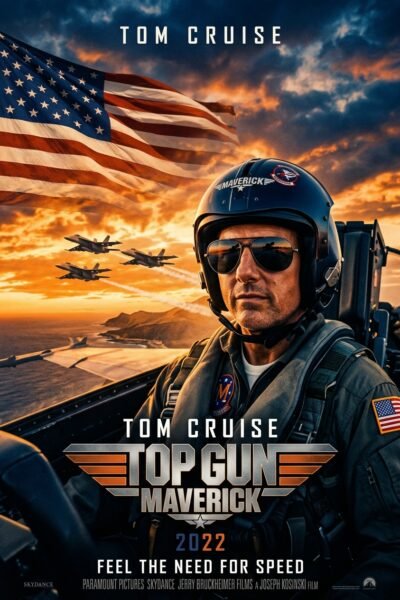
Introduction: The Impossible Sequel That Became a Masterpiece
No rational film analyst expected Top Gun: Maverick to be as extraordinary as it is. The original Top Gun (1986) was a product of its specific cultural moment — a Reagan-era military recruitment fantasy, beloved for its pop soundtrack and homoerotic volleyball and Kenny Loggins, but not exactly a landmark of cinematic craft. A sequel released thirty-six years later, with its star four decades older and the cultural context entirely different, should by all logic have been an irrelevant nostalgia exercise. Instead, it became one of the finest action films in cinema history — the most commercially successful film of 2022 and a critical triumph that demonstrated what blockbuster filmmaking can achieve when executed by genuinely gifted craftspeople committed to the highest standards.
The Mission: Practical Filmmaking as a Moral Stance
Tom Cruise’s commitment to practical action filmmaking has become one of contemporary Hollywood’s most discussed creative philosophies. For Maverick, he didn’t merely insist on practical effects — he put his cast through actual naval aviation training, requiring months of preparation before they were allowed anywhere near a jet. The actors flew in actual F/A-18 Super Hornets, experiencing real G-forces, shot by cameras mounted in actual cockpits. The physics of these sequences — the distortion of faces under gravitational stress, the visceral sense of speed and altitude, the terrifying fragility of a human body in a machine traveling at Mach speed — cannot be replicated digitally. You feel it.
📖 Also Read
The film’s training sequences, in which Maverick teaches a group of elite pilots the skills required for a seemingly impossible mission, derive their tension from this commitment to authenticity. When Miles Teller’s Rooster pulls out of a steep dive with two seconds to spare, the G-force distorting his face and the relief in his eyes, it reads as genuine because it is genuine. Joseph Kosinski knew that the action sequences needed to be earned by the emotional material preceding them — and vice versa — and Maverick achieves this balance throughout.
Tom Cruise: A Movie Star Defining the Final Term
Tom Cruise is 60 years old, and watching him in Maverick is to watch a performer who has spent four decades perfecting his craft arrive at something close to its definitive expression. He plays Pete “Maverick” Mitchell with layers that the original film never permitted: the weight of decades, the awareness of mortality that makes recklessness a form of denial, the profound guilt of surviving when better men didn’t. Goose’s death in the original hangs over this film like a ghost — and the central relationship between Maverick and Rooster (Miles Teller), Goose’s son, gives the sequel an emotional spine that transforms a sequel into something genuinely moving.
Cruise’s scenes with Jennifer Connelly (playing a new romantic interest, Penny Benjamin) are warmer and more emotionally generous than anything in the original film. And his scenes with Val Kilmer — Kilmer reprising his role as Iceman in sequences acknowledging the actor’s real-life throat cancer — achieve a genuine emotional weight that belongs to cinema’s most moving farewell moments.
Joseph Kosinski’s Direction: Thrills with Emotional Intelligence
Joseph Kosinski directs Maverick with the technical precision of an engineer and the emotional intelligence of a filmmaker who understands that spectacle must be earned. He paces the film superbly — there’s genuine breathing room between action sequences, time for character, humor, and the development of the father-son dynamic between Maverick and Rooster that gives the climax its emotional resonance. The final mission sequence — the attack on the uranium enrichment facility — is a thirty-minute sustained achievement in action filmmaking that includes some of the most spectacular practical aerial footage ever captured.
The Legacy: Why Maverick Matters
Top Gun: Maverick’s commercial success — it earned nearly $1.5 billion worldwide — demonstrated something important about the state of cinema in the post-pandemic landscape: audiences will return to theaters for the right film, and the right film is one that offers something genuinely impossible to replicate on a television screen. The experience of watching Maverick on a large screen, with a full sound system delivering those jet engines at full volume, is categorically different from watching it on a streaming service.
Our Rating: ⭐ 9.1 / 10
Verdict: Top Gun: Maverick is the best pure action film of the decade — spectacular, emotional, expertly crafted, and utterly committed to the proposition that movies are better when they’re real. See it on the biggest screen available.
Why This Film Matters: Legacy and Impact
Top Gun: Maverick arrived at a moment when cinema needed it — a film that reminded audiences why the theatrical experience is irreplaceable, why the collective engagement of a packed cinema creates something that no home viewing experience can replicate. It generated genuine communal emotion: laughter at the right moments, silence at others, and that particular quality of collective investment that transforms individual entertainment into shared cultural experience.
The film’s legacy extends beyond its immediate commercial success. It demonstrated to the industry that audiences retain the capacity for genuine emotional engagement with well-crafted entertainment — that cynicism and formula are not inevitable, that films made with real creative ambition and genuine craft can find their audience and reward it. In this sense, Top Gun: Maverick is not just a great film but an argument for filmmaking itself.
The performances, the technical achievements, the emotional honesty — all of these elements combine to create something that justifies cinema’s claim to be an art form as much as an entertainment industry. Top Gun: Maverick is one of those films that reminds you, viscerally, why you fell in love with movies in the first place.
Final Verdict
Essential viewing. Top Gun: Maverick earns every superlative applied to it, delivers genuine entertainment alongside genuine craft, and leaves you with the particular satisfaction of having witnessed something done extremely well. This is what cinema at its best looks like.
[…] ▶ Top Gun: Maverick (2022) Review – The Best Action Film of the Decade […]
[…] ▶ Top Gun: Maverick (2022) Review – The Best Action Film of the Decade […]