
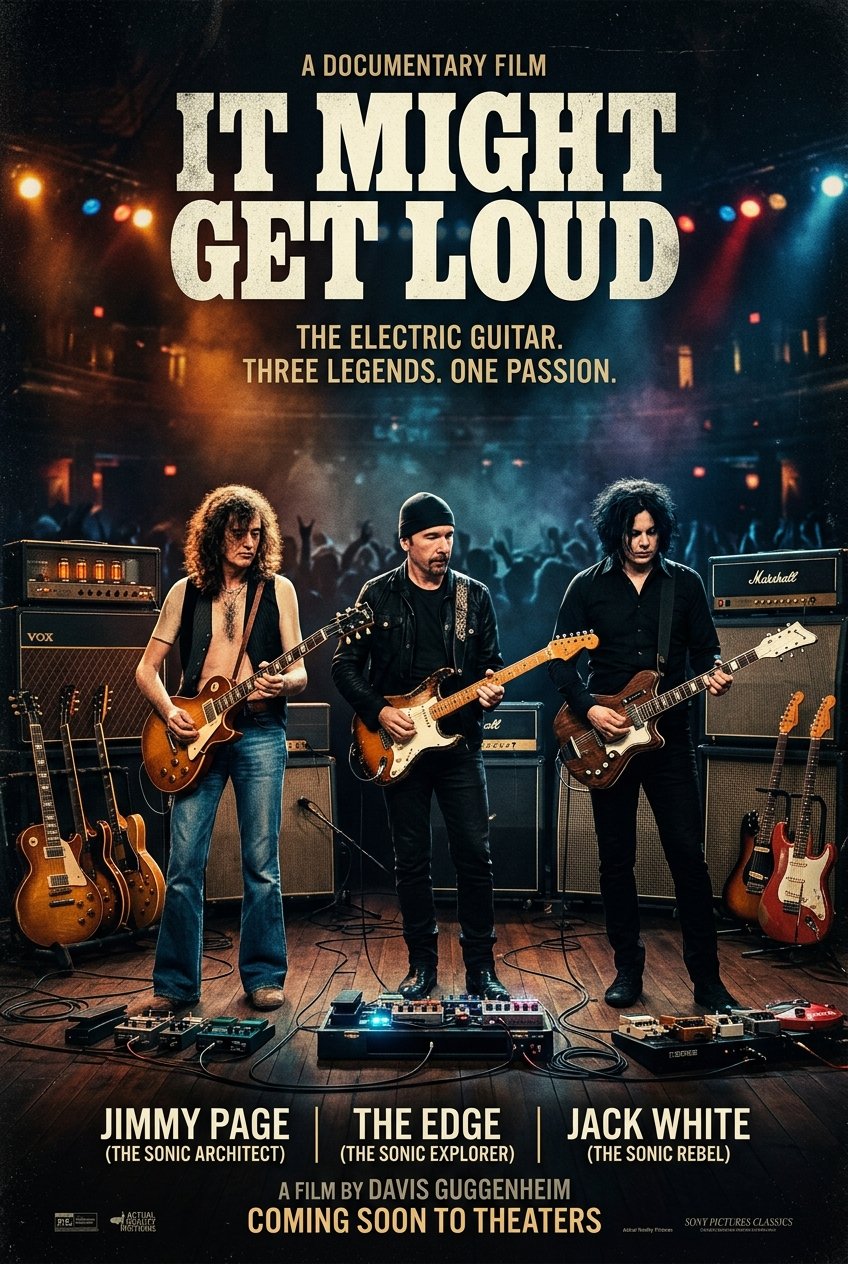
| Director | Davis Guggenheim |
|---|---|
| Featured Guitarists | Jimmy Page (Led Zeppelin), The Edge (U2), Jack White (The White Stripes) |
| Release Date | August 14, 2009 (USA) |
| Genre | Music Documentary |
| Runtime | 98 minutes |
| Studio | Sony Pictures Classics / Thomas Tull |
| Our Rating | 8.7 / 10 |
Three Generations, Three Sonic Philosophies, One Electric Guitar
In the pantheon of music documentaries, It Might Get Loud (2008), directed by Academy Award winner Davis Guggenheim, stands as an unrepeatable monument to the electric guitar. By assembling three legendary guitarists across distinct eras of rock history — Jimmy Page of Led Zeppelin, The Edge of U2, and Jack White of The White Stripes — the film constructs a captivating narrative about artistic philosophy, sonic innovation, and the enduring primal power of six strings attached to a wooden body.
The Genesis of the Electric Summit
The central conceit of It Might Get Loud is simple yet revolutionary: bring three guitar titans into an empty soundstage in Dublin, Ireland, without scripts or pre-arranged setlists, and allow them to converse, demonstrate their techniques, and jam together. The contrast between their approaches to the instrument forms the dramatic engine of the documentary.
Jimmy Page represents the romantic, blues-infused origins of heavy rock and roll in 1960s London. Filmed walking through Headley Grange — the English country house where Led Zeppelin recorded Led Zeppelin IV — Page recounts discovering skiffle records as a teenager, his early days as London most sought-after session guitarist playing on hits by The Kinks, Shirley Bassey, and Who, and developing the bowed Gibson Les Paul technique that defined rock royalty.
The Edge embodies the technological architect. Shot against the bleak coastal beauty of Dublin and his recording studio, Dave Evans explains how he embraced delay pedals, echoes, and rack-mounted digital processors to overcome his technical limitations, transforming simple arpeggiated chords into towering, atmospheric soundscapes for U2 songs like Where the Streets Have No Name and Sunday Bloody Sunday.
Jack White serves as the minimalist purist. Operating out of a rural farm in Tennessee, White rejects modern technological conveniences in favor of struggle and deliberate physical tension. Filmed building a makeshift one-string Diddley bow from a wooden plank, a glass bottle, and a rusty nail, White famously declares: “Who says you need to buy a guitar?”
Deep Dive: Guitar Gear, Amplifiers, and Tone Secrets
Beyond the personal reflections of its leads, It Might Get Loud offers guitar gear aficionados a masterclass in tone creation. Page details his iconic 1959 Fender Telecaster (given to him by Jeff Beck) and his main stage instrument, a 1959 Gibson Les Paul Standard plugged into vintage Marshall and Supro amplifiers. He reveals how mic placement in stairwells contributed to the massive drum and guitar sounds on When the Levee Breaks.
The Edge opens up his extensive rack-mount pedalboard system, showing how the Electro-Harmonix Memory Man analog delay unit gave U2 its signature ambient chiming signature. White showcases his bargain-bin Airline guitar made of Res-O-Glas plastic, explaining that he chooses cheap, difficult instruments specifically because fighting the instrument produces a more visceral, emotional performance.
Unforgettable Musical Moments
The film most breathtaking sequence occurs when Jimmy Page picks up his iconic 1960 Gibson Les Paul Standard and launches effortlessly into the opening riff of Whole Lotta Love. Watching Jack White and The Edge lean forward with the uninhibited wide-eyed joy of teenage fans remains one of the most heartwarming moments in rock documentary history. Equally moving is their closing acoustic rendition of The Band The Weight, where three distinct musical voices blend into effortless harmony.
Historical Context and Structural Analysis
What sets It Might Get Loud apart from standard rock documentaries is its fluid non-linear structure. Director Davis Guggenheim seamlessly weaves individual biographical chapters with shared studio sessions. We watch Jimmy Page reflect on how hearing Link Wray Rumble as a boy sparked his lifelong obsession with guitar distortion. We follow The Edge into a Dublin record store where he bought his first Gibson Explorer in 1978, discovering how post-punk minimalism gave birth to U2 stadium sound. We see Jack White performing in his teenage garage band The Upholsterers, stripping away production fluff to find raw blues energy.
Cultural Legacy and Impact on Future Musicians
Since its release, It Might Get Loud has become a rites-of-passage film for aspiring guitarists worldwide. It demystifies the creative process, demonstrating that musical genius is not merely a matter of technical velocity, but rather a relentless pursuit of personal expression. By placing Page 1970s blues-rock, The Edge 1980s post-punk minimalism, and White 2000s garage rock revival side by side, the film proves that the electric guitar remains an endlessly malleable tool for human storytelling.
Cinematography and Sound Engineering
Guggenheim and cinematographer Erich Roland shoot the film with rich 35mm texture and intimate close-ups of tubes glowing inside vintage Supro amplifiers, custom pedalboards, and worn fretboards. The audio mixing is immaculate, allowing every harmonic resonance, feedback squeal, and acoustic resonance to vibrate with physical weight.
What Works
- Extraordinary candid chemistry between Jimmy Page, The Edge, and Jack White
- Deep exploration of artistic philosophy beyond mere technical shredding
- Iconic scene of Jimmy Page playing Whole Lotta Love at Headley Grange
- Stunning 35mm visual aesthetics and pristine audio mixing
- Inspiring look at how physical limitations breed creative innovation
Minor Criticisms
- Leaves out heavier 1980s metal and modern progressive guitar evolutions
Final Verdict
It Might Get Loud is essential viewing not just for guitar players, but for anyone fascinated by the creative impulse. It captures the soul of electric guitar music with rare intelligence and joy.
MovieOn Rating: 8.7 / 10
Leave a Reply