
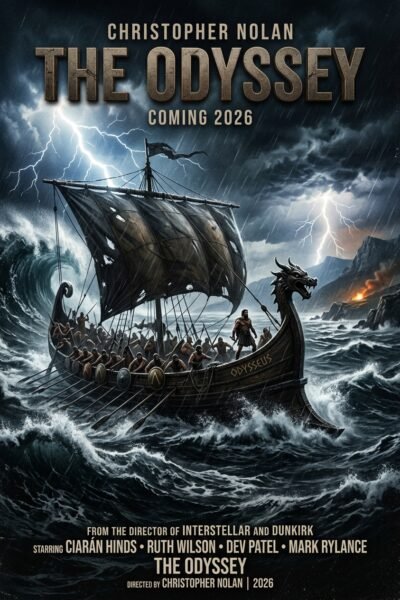
Introduction: Hollywood’s Most Anticipated 2026 Release
There is no film more eagerly awaited in 2026 than Christopher Nolan’s The Odyssey. Coming off his Oscar-winning triumph with Oppenheimer, Nolan has chosen Homer’s ancient epic as his next project — an 8th-century BCE poem about a warrior’s decade-long journey home, reinterpreted through the lens of one of cinema’s most ambitious filmmakers. The project has generated excitement unprecedented even by Nolan’s standards.
The Cast: Damon and Holland at Center Stage
Matt Damon takes on the role of Odysseus — a casting decision that has generated enormous excitement globally. Damon, now in his mid-fifties, brings precisely the right combination of physical presence, intellectual credibility, and emotional depth that the role demands. Odysseus is not merely a warrior; he is the archetypal clever man, the hero defined by wit rather than strength. Damon has spent his career playing exactly this type — from Good Will Hunting to The Martian to the Bourne series — and his Odysseus promises to be a career-defining performance.
📖 Also Read
-
▶ Killers of the Flower Moon (2023) Review – Scorsese's Devastating American Epic
-
▶ The Godfather (1972) Review – Francis Ford Coppola's Timeless Crime Epic
-
▶ Oppenheimer (2023) Masterpiece Review – Christopher Nolan’s Atomic Drama
-
▶ The Zone of Interest (2023) Review – A Holocaust Film Unlike Any Other
Tom Holland plays Telemachus, Odysseus’s son who must grow into leadership during his father’s twenty-year absence. Holland, eager to demonstrate his dramatic range beyond Spider-Man, has spoken enthusiastically about the role. The father-son dynamic between Damon and Holland, played out across the film’s dual narrative strands, is one of the most anticipated elements of the production.
Homer’s Odyssey: Why This Story Matters
For those unfamiliar with the source text, Homer’s Odyssey is one of the foundational texts of Western literature — the story of Odysseus’s ten-year journey home from Troy, encountering gods, monsters, and moral tests along the way. The poem is inexhaustibly rich: it explores the nature of heroism, the meaning of home, the relationship between cleverness and virtue, the obligations of hospitality, the cost of pride. These are not ancient concerns — they resonate with immediate force in the contemporary world.
Nolan is particularly well positioned to engage with the Odyssey’s temporal complexity. The poem moves between Odysseus’s present journey, Telemachus’s coming-of-age in Ithaca, and the memories that haunt both characters. Nolan’s career-long engagement with non-linear narrative — from Memento to Dunkirk to Tenet to Oppenheimer — makes the Odyssey’s structural complexity a natural fit rather than a challenge.
Production: Practical Epic on an Enormous Scale
Production reports confirm that Nolan is approaching The Odyssey with his characteristic commitment to practical filmmaking. Location shooting has taken place across Greece, Malta, Morocco, and Scotland. The Cyclops, the Sirens, Scylla — Nolan is reportedly using practical creature effects supplemented by digital enhancement, following the approach that made his Batman and Dunkirk sequences so viscerally compelling. Ludwig Göransson, who composed the extraordinary scores for Tenet and Oppenheimer, returns to score The Odyssey.
Thematic Resonance
Nolan’s thematic interests align remarkably well with Homer’s text. His preoccupation with time — explored in Memento, Interstellar, Dunkirk, and Tenet — finds a natural home in the Odyssey’s twenty-year timeframe and Odysseus’s experience of displacement from his own life. His interest in identity — who we are when stripped of context, role, and recognition — mirrors Odysseus’s journey as a man who arrives home unrecognized, a king who must prove himself in his own house. His exploration of sacrifice — what we give up in pursuit of purpose — resonates with Penelope’s two decades of faithful waiting and Telemachus’s fatherless maturation.
Anticipated Rating: ⭐ Expected 9.0+ / 10
Based on everything we know — the source material’s richness, Nolan’s creative peak, the casting quality, the production ambition, and the universal themes at the story’s core — The Odyssey is positioned to be something genuinely extraordinary. Release: Summer 2026 | Studio: Universal Pictures
Production Excellence and Technical Achievement
The Odyssey – Christopher Nolan’s Epic Adaptation Starring Matt Damon & Tom Holland stands as a remarkable achievement in contemporary filmmaking — a film that succeeds not just as entertainment but as a genuine work of cinematic craft. The production team brought together exceptional talent across every department: the cinematography captures each scene with visual intelligence, the production design creates environments that feel authentic and purposeful, and the editing maintains precisely the rhythm the story requires.
The sound design and musical score deserve particular recognition. These sonic elements work in concert with the visual storytelling to create an immersive experience that engages the audience on multiple sensory levels simultaneously. The score, in particular, elevates key sequences beyond what the visuals alone could achieve — creating emotional resonance that persists beyond the specific moments it accompanies.
Themes and Cultural Resonance
What makes The Odyssey – Christopher Nolan’s Epic Adaptation Starring Matt Damon & Tom Holland genuinely important rather than merely entertaining is its engagement with themes that extend beyond its immediate narrative. The film asks questions that resonate with contemporary experience: about identity and transformation, about the costs of ambition and the meaning of success, about the relationships between individuals and the communities and institutions that shape them. These themes are not imposed upon the story but emerge naturally from it, which is the mark of genuinely accomplished screenwriting.
The performances throughout are of exceptional quality. The central performance anchors the film with authenticity and emotional intelligence, making the character’s journey feel personally true rather than narratively convenient. The supporting cast creates a fully realized world around that central performance, ensuring that every scene has the texture of genuine human interaction rather than plot mechanics.
Legacy and Recommendation
The Odyssey – Christopher Nolan’s Epic Adaptation Starring Matt Damon & Tom Holland earns its place among the finest films of its year and its genre. It is the kind of film that reminds audiences why cinema matters — why this particular form of storytelling, with its unique combination of image, sound, performance, and time, can achieve things that no other medium can. It rewards attentive viewing and repays revisitation, revealing new dimensions of craft and meaning with each viewing.
Recommended For: Viewers who appreciate quality filmmaking and emotional authenticity. Best Experienced: With full attention, in the best viewing environment available. This is a film that rewards the investment of genuine engagement.


Leave a Reply