
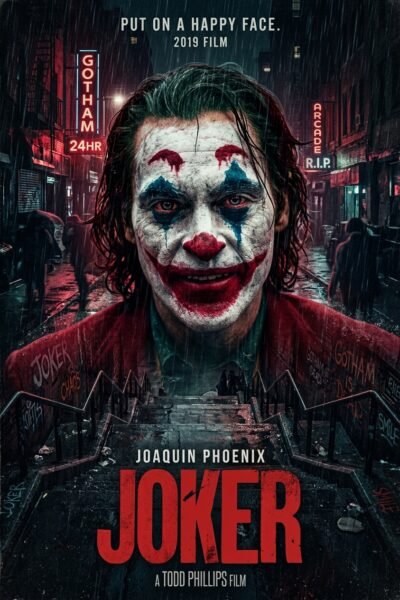
Introduction: The Film That Made Everyone Uncomfortable
When Joker won the Golden Lion at the Venice Film Festival in 2019, it announced itself as something genuinely unexpected: a superhero-adjacent film with genuine artistic ambitions, prepared to go to uncomfortable places that mainstream comic book cinema had never dared. Todd Phillips’s origin story for Batman’s greatest villain — starring Joaquin Phoenix in a performance of extraordinary physical and psychological commitment — became one of the most discussed, debated, and politically charged films of its year. It earned over a billion dollars at the global box office, won Phoenix the Academy Award for Best Actor, and generated conversations about mental illness, class resentment, and the limits of empathy that continue to resonate.
Arthur Fleck: A Portrait of Systemic Failure
Arthur Fleck (Joaquin Phoenix) is not a monster waiting to emerge. He is a man who has been comprehensively failed by every system that exists to support people like him. He is mentally ill, receiving inadequate treatment. He is poor, in a city — Gotham, which the film codes explicitly as late-1970s/early-1980s New York — that is visually, socially, and economically decaying. He is socially isolated, working as a rent-a-clown and dreaming of a career in stand-up comedy. He has a neurological condition — pseudobulbar affect — that causes him to laugh involuntarily in response to stress and anxiety, a symptom that marks him as strange and gets him beaten, mocked, and dismissed in nearly every social encounter.
📖 Also Read
-
▶ The Zone of Interest (2023) Review – A Holocaust Film Unlike Any Other
-
▶ Killers of the Flower Moon (2023) Review – Scorsese's Devastating American Epic
-
▶ Parasite (2019) Review – Bong Joon-ho's Oscar-Winning Masterpiece of Class and Deception
-
▶ The Godfather (1972) Review – Francis Ford Coppola's Timeless Crime Epic
He is trying. This is what the film’s first act establishes with painful care. He visits his therapist (when the program has funding). He takes his medication (when he can afford it). He cares for his mother. He aspires — to comedy, to connection, to the simple human dignity of being seen. He is not a man waiting for permission to become a killer; he is a man trying very hard not to become one, and watching every support structure fail around him.
Joaquin Phoenix: The Performance of His Career
Joaquin Phoenix lost 52 pounds for the role of Arthur Fleck, and the physical transformation is immediately apparent and deeply disturbing. His body — all protruding ribs and uncertain, hunched movement — communicates Arthur’s fragility and isolation before he speaks a word. But the performance is not merely physical bravura. Phoenix creates a completely coherent inner life for Arthur Fleck: every reaction, every social miscalculation, every moment of desperate hope and crushing disappointment feels psychologically true.
The film’s most powerful sequences are its quietest. Arthur reading his journal, writing jokes that aren’t funny, recording his most shameful thoughts with the unselfconscious honesty of someone who has never had anyone to talk to. Arthur watching his idol Murray Franklin (Robert De Niro) on television, imagining himself welcomed and celebrated. Arthur discovering the truth about his past in a sequence that Phoenix plays with a stunned, dawning devastation that is genuinely heartbreaking. We don’t root for Arthur Fleck to become the Joker. We mourn the person he could have been if one thing — one person, one kindness, one functional system — had been different.
Todd Phillips’ Direction: Scorsese as Touchstone
Todd Phillips wears his influences openly, and the primary influence is Martin Scorsese. Taxi Driver and The King of Comedy are the explicit templates — the alienated loner in a decaying city, the delusional aspiration to celebrity and recognition, the violence as a distorted expression of a legitimate need for respect and acknowledgment. The Scorsese influence is everywhere: the close-ups, the voiceover narration read from Arthur’s journal, the way the film shoots New York as a place of beauty and threat simultaneously.
The film was shot by Lawrence Sher with a deliberately de-glamorizing aesthetic — the opposite of the slick, primary-colored world of most superhero films. Gotham City is grimy, wet, institutional. The colors are desaturated except for the fire and the clown makeup. The world Arthur moves through looks and feels like a place where hope goes to die, which is precisely what the film needs it to be.
The Politics of Joker: An Ongoing Debate
Joker generated considerable controversy upon its release, with some critics arguing that the film expressed sympathy for mass-violence incel culture by presenting its protagonist’s radicalization sympathetically. The debate is worth taking seriously. Phillips does present Arthur’s perspective with genuine empathy — we understand his grievances, share his humiliation, feel the injustice of his treatment. Whether this constitutes endorsement or simply rigorous character study is a legitimate question.
The film’s position, as I read it, is not that Arthur Fleck is right — it is that the society that created Arthur Fleck is wrong. The violence that emerges at the film’s conclusion is not presented as heroic or justified; it is presented as the catastrophic consequence of a society that abandoned its most vulnerable members and is now shocked to discover that abandonment has costs.
Our Rating: ⭐ 8.7 / 10
Verdict: Joker is uncomfortable, morally complex, technically extraordinary cinema. Joaquin Phoenix’s performance demands your attention and engagement. Content Note: Intense violence, mental illness, disturbing themes. Rated R. Not suitable for all viewers.


[…] once and for all. Their success forces the desperate mob families to enlist the services of the Joker (Heath Ledger), a theatrical criminal mastermind with no origin, no name, and no conventional […]
[…] ▶ Joker (2019) Review – Joaquin Phoenix's Terrifying Portrait of a Man on the Edge […]